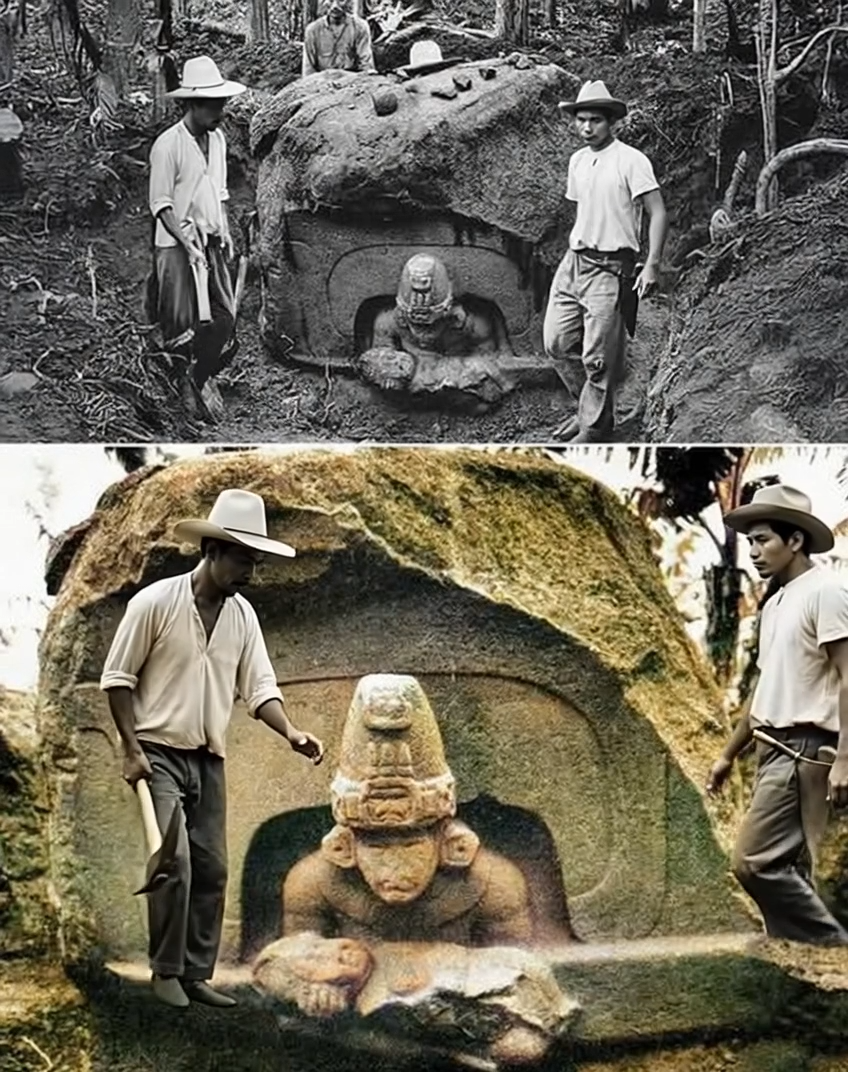
The artifact shown in the provided archival pH๏τograph is Olmec Altar 4 (now more accurately classified by archaeologists as a “throne”). It dates back to the Middle Formative period, specifically between 900 and 400 BC. The object was discovered at the monumental site of La Venta, located in the modern-day state of Tabasco, Mexico. La Venta served as the primary civic-ceremonial center of the Olmec civilization—the “mother culture” of Mesoamerica—after the decline of San Lorenzo. Situated on an island ridge amidst a sea of coastal swamps, this site was a concentrated landscape of power where Altar 4 was strategically placed alongside other mᴀssive stone sculptures to define sacred space and political authority.

From an archaeological standpoint, Altar 4 is a masterpiece of prehistoric lithic technology, carved from a single, mᴀssive block of basalt. The raw material originated in the Tuxtla Mountains, located over 60 miles (100 km) away from La Venta. The logistical feat of transporting a stone weighing approximately 30 tons through dense jungle and swampy terrain suggests a highly organized social hierarchy. The craftsmanship exhibits a sophisticated mastery of abrasive carving; the Olmec artisans utilized stone chisels and quartz sand abrasives to create the deep, recessed “cave” niche and the high-relief figure emerging from it. The top of the stone is flat and features a slight overhang, a design element that originally led early explorers to misidentify these objects as sacrificial altars rather than the royal thrones they are understood to be today.
The iconography of Altar 4 is a profound representation of Olmec cosmology and the divine right of kingship. The central figure is a ruler seated in a “cross-legged” position, emerging from a cave-like niche that represents the mouth of the Earth Monster or the entrance to the Underworld (Xibalba). Above the figure, the stylized eyes and fangs of a celestial or terrestrial predator are visible, signifying the ruler’s connection to the supernatural. The figure holds a thick rope that winds around the base of the throne; on the side panels (not fully visible in the front view), this rope is often shown tethered to a captive. This “rope of lineage” symbolizes both the ruler’s power over enemies and his ancestral connection to the earth, positioning the monarch as the vital mediator between the mundane world and the spirit realm.

While initially dubbed “altars,” modern archaeological consensus, championed by scholars like David Grove, identifies these monuments as thrones (asientos) for Olmec lords. The flat top provided a stage for the ruler during public ceremonies, physically elevating him above the populace. The symbolic “cave” beneath the seat served as a potent visual metaphor: when the king sat upon the throne, he was literally supported by the mouth of the earth and his ancestors. This was a tool of ideological legitimation, communicating that the ruler’s authority was not merely political but cosmologically ordained. The throne acted as a topogram, a physical location that condensed the entire Olmec universe—sky, earth, and underworld—into a single ritual focal point.
The pH๏τograph captures a pivotal moment in the history of American archaeology. Altar 4 was first brought to international scholarly attention by Frans Blom and Oliver La Farge during their 1925 expedition. However, the most significant systematic excavation of the monument occurred in the late 1930s and early 1940s under Matthew Stirling, supported by the Smithsonian Insтιтution and the National Geographic Society. Stirling’s work at La Venta was revolutionary; it helped establish the Olmec as a culture older than the Maya, a claim that was controversial at the time. Today, the monument has been moved to the Parque-Museo La Venta in Villahermosa to protect it from the industrial erosion of its original find-spot, where it remains a cornerstone for our understanding of Mesoamerican antiquity.