Archaeological Analysis of Abuna Yemata Guh: A 6th-Century Monolithic Rock-Hewn Church in the Gheralta Mountains of Tigray, Ethiopia
Abuna Yemata Guh stands as one of the most extraordinary and inaccessible rock-hewn religious sites in the world, dramatically carved directly into a vertical sandstone cliff face in the Gheralta mountain range of northern Ethiopia. Situated at an elevation of approximately 2,580 meters above sea level and positioned roughly 200 to 250 meters above the surrounding terrain, this architectural marvel is part of the largest concentration of rock-cut churches in the region. The physical remains require a perilous vertical ascent using hand and footholds pecked into the stone, culminating in a narrow ledge crossing with a sheer drop on either side. From an archaeological standpoint, the site represents a remarkable fusion of sacred geography, architectural isolation, and medieval Christian heritage in East Africa.
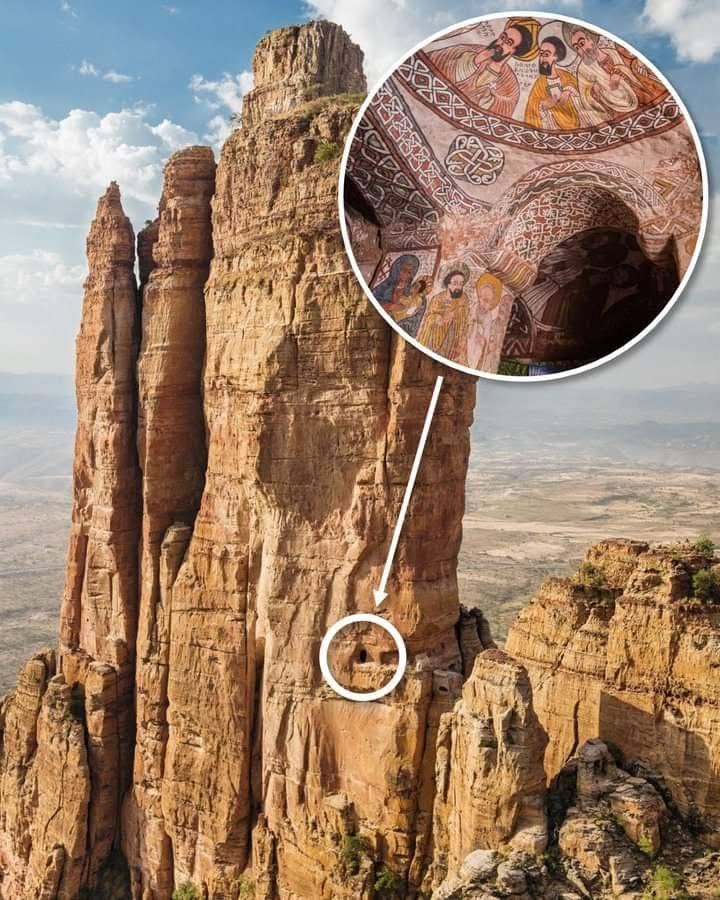
Chronologically, local tradition and historical accounts attribute the initial creation of the church to the 6th century A.D., linking it to Abuna Yemata, one of the legendary Nine Saints who traveled to Ethiopia during the period of intense Christian expansion. While the primary architectural excavation of the monolithic chapel dates back to this early Christian era, subsequent interior artwork underwent later phases of embellishment. Detailed stylistic and scientific analyses of the wall and dome paintings place their execution in the latter half of the 15th century. This multi-phase chronological depth illustrates how subsequent generations continually returned to maintain, decorate, and preserve this high-alтιтude sanctuary across more than a millennium.
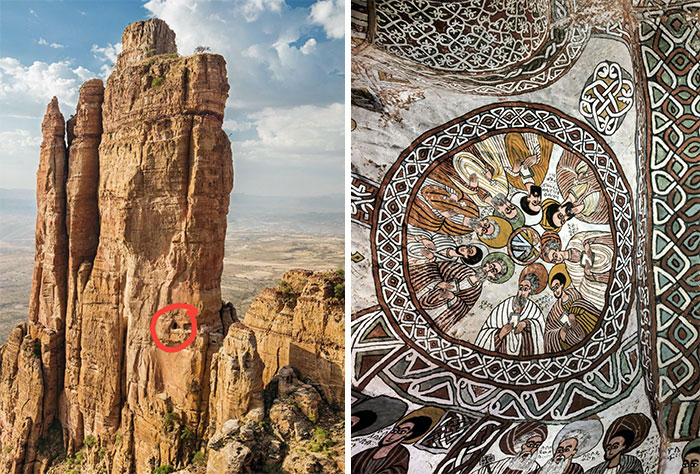
In terms of material composition and structural detailing, the entire church and its internal architectural elements—including pillars, arches, and cupolas—were hewn subtractively from local Enticho and Adigrat Sandstones, which form the upper erosional remnants of the regional geological strata. The interior surfaces feature well-preserved frescoes painted directly onto the stone wall matrix using natural local pigments, depicting biblical themes such as the Twelve Apostles, Old Testament figures, and various saints written in Ge’ez scripts. Archaeological studies utilizing X-ray fluorescence have confirmed that these 15th-century pigments were sourced locally without complex underlying preparation layers, demonstrating sophisticated medieval craftsmanship executed under extreme physical constraints.
The functional significance of Abuna Yemata Guh extends far beyond standard liturgical worship, embodying deep spiritual protection, seclusion, and communal resilience. Historical accounts suggest that the choice of such an extreme, vertical cliffside location served a strategic defensive purpose during eras of regional conflict and religious persecution, providing a secure sanctuary for monks and local Christian communities. Spiritually, the arduous physical climb acts as a profound metaphor for spiritual devotion, drawing pilgrims and resident priests who maintain active Orthodox Christian services to this day. Furthermore, the preservation of ancient goatskin-bound religious texts inside the dry chambers provides invaluable primary source materials for the study of medieval Ethiopian liturgy and manuscript production.
The discovery and academic documentation of these remote rock-hewn complexes have been advanced through collaborative efforts involving regional heritage authorities, Ethiopian ecclesiastical custodians, and international archaeological missions. Modern non-invasive documentation, pigment analysis, and structural conservation projects—such as those evaluating weathering vectors on the fragile sandstone—help safeguard the site against environmental decay and increasing visitor impact. Today, Abuna Yemata Guh remains protected under national cultural heritage frameworks and continues to be studied by researchers investigating the unique architectural traditions, sacred art, and deep historical continuity of the Ethiopian Orthodox Tewahedo Church.
✓ hoangduc
Abuna Yemata Guh stands as one of the most extraordinary and inaccessible rock-hewn religious sites in the world, dramatically carved directly into a vertical sandstone cliff face…