Archaeological and structural-geological analysis of the coastal rock formation Sail Rock (Skala)
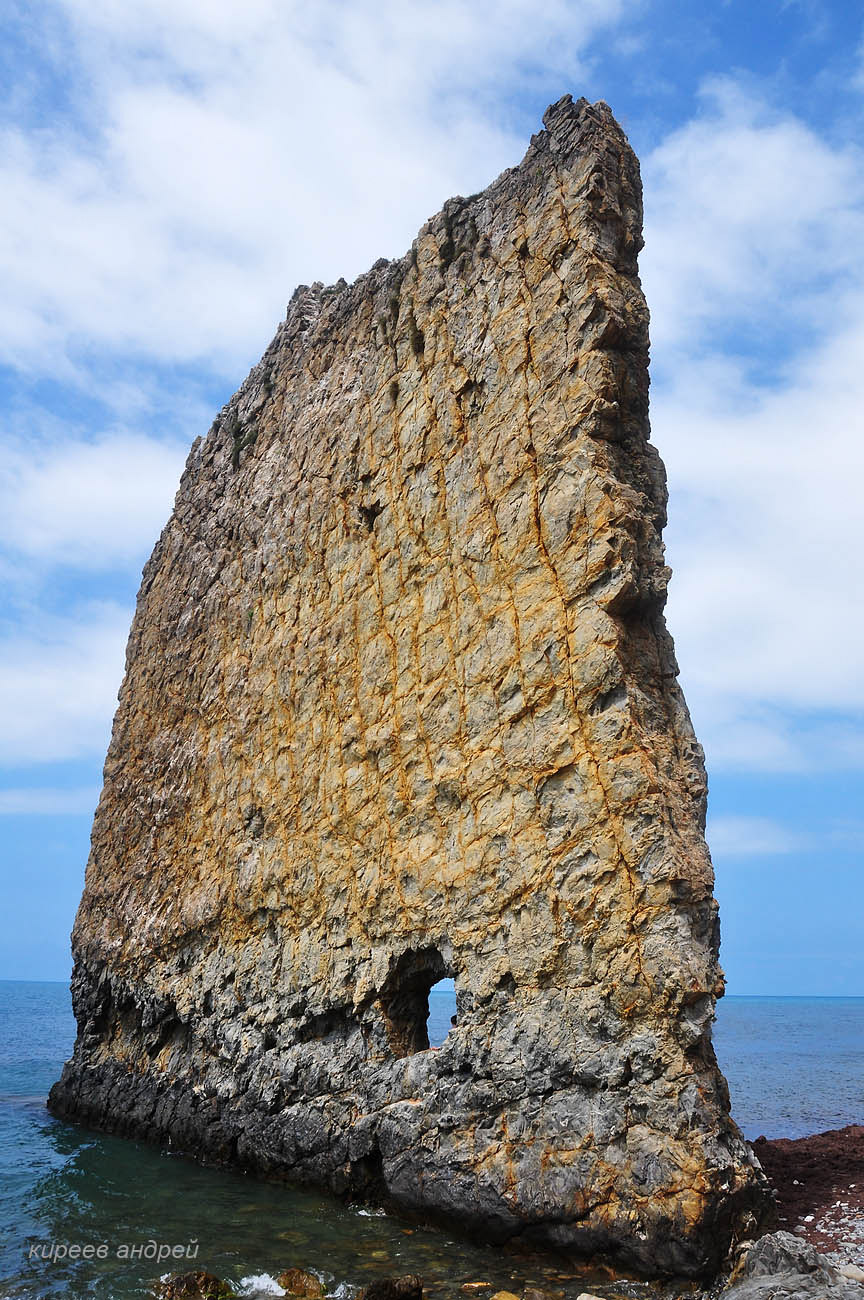
The towering, sail-shaped rock formation captured in the image—commonly known as Sail Rock (or *Skala Parus*)—is a unique natural geological wonder situated right along the Black Sea coast near Gelendzhik, Russia. From the perspectives of landscape archaeology and human geography, this formation has long transcended the status of a mere scenic attraction, serving instead as a vital natural navigational landmark for ancient maritime routes along the coast. Standing approximately 30 meters tall and 25 meters long, yet measuring little more than a meter in thickness, the rock rises proudly amidst the waves like a fortified wall erected by nature. Its striking presence has captivated humans since prehistoric times, transforming the surrounding area into a hub for indigenous inhabitants to pause, observe, and trade over the centuries.
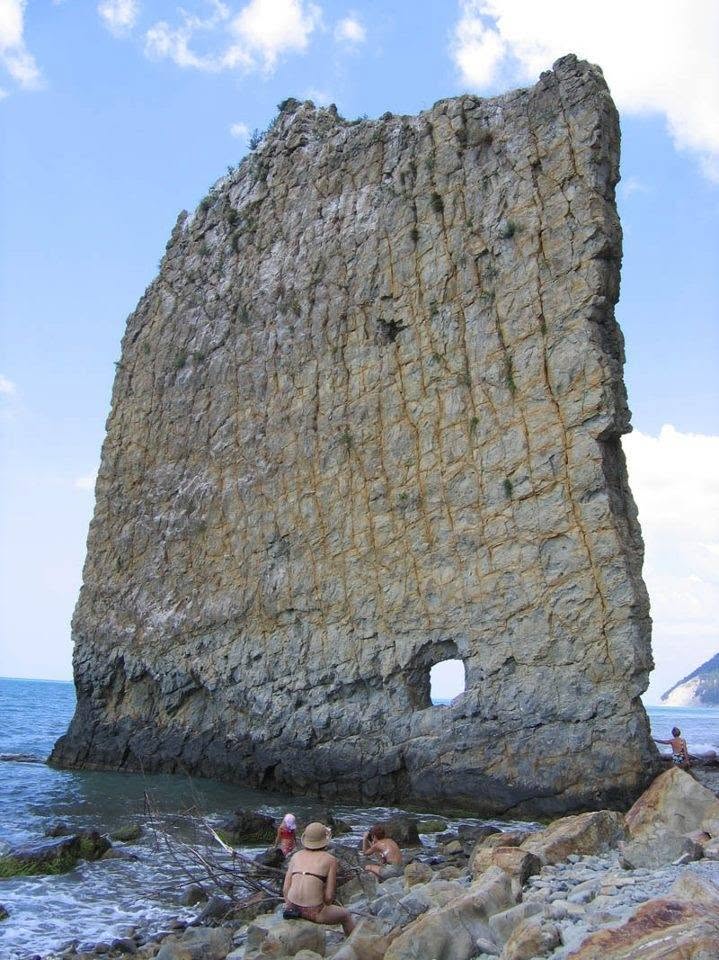
Sail Rock is primarily composed of fine-grained sandstone and hard limestone, materials formed through marine sedimentation processes spanning millions of years of Earth’s history. A feature that particularly intrigues geologists and archaeologists is the pattern of regular, block-like fissures running across the surface, creating the impression of bricks or stone blocks stacked and exquisitely carved by human hands. Additionally, a prominent circular hole pierces the rock face at a moderate height above the ground; this feature has sparked significant debate regarding whether it served as an ancient military defensive embrasure or resulted from natural erosion caused by wind and waves. Despite enduring millennia of harsh marine erosion, the rock structure retains its remarkably flat, sail-like shape—a rarity worldwide. This rock formation held multifaceted significance and utility for the communities that historically inhabited or traversed this coastal region. Throughout the evolution of indigenous cultures and the era of ancient maritime trade, Sail Rock served as a natural beacon, aiding sailors in navigation along the treacherous Black Sea coast. Notably, the peculiar aperture in the lower section of the rock was the subject of speculation in folklore and among 19th-century explorers; theories ranged from it being a cannonball hole from military skirmishes to a man-made opening intended for surveillance or observation. Although modern scientists have demonstrated that the hole was primarily formed through the micro-weathering of softer internal rock layers, it retains profound spiritual and symbolic value for the local population.
The discovery, documentation, and scientific study of Sail Rock are linked to 19th-century Russian geographical and archaeological expeditions, most notably the records made in 1858 by the renowned Russian naturalist and explorer Mikhail Veniukov. Subsequent archaeologists and geologists conducted comprehensive field surveys, analyzing deep-seated sedimentary structures, measuring geometric parameters, and searching for traces of human activity on the beach surrounding the rock’s base. These research efforts have not only elucidated the unique formation process of this sail-shaped rock but also provided valuable data regarding the history of coastal settlement and resource utilization by ancient peoples in the Caucasus region.

Today, Sail Rock is a state-protected natural monument that attracts a large number of scientists, geologists, and tourists for both research and sightseeing. Preserving this area is essential to maintaining one of the Russian coast’s most remarkable geological landmarks, while also opening up opportunities for interdisciplinary research combining Earth sciences and space archaeology. Standing tall amidst the wind and waves for millions of years, this rock formation remains a powerful testament to nature’s tectonic forces and an integral part of the cultural and historical heritage of the Gelendzhik region.
✓ Ryan Mitchell
The towering, sail-shaped rock formation captured in the image—commonly known as Sail Rock (or *Skala Parus*)—is a unique natural geological wonder situated right along the Black Sea…