Architectural Masterpiece of the Islamic Golden Age: An Archaeological Analysis of the Gonbad-e Qabus Tower
The Gonbad-e Qabus Tower is located on a low artificial mound at the edge of the ancient city of Gorgan in the Golestan Province of northeastern Iran. Geographically positioned within a historic region that served as a major urban and cultural center during the medieval Islamic era, the monument stands prominently on a plain, making it visible from miles away. The site itself acts as a solitary surviving landmark of a once-thriving capital, symbolizing the intersection of nomadic traditions and settled Islamic architecture in northern Iran.
Chronologically, the construction of this monumental funerary tower dates back to the early 11th century CE, specifically completed in the year 1006 or 1007 CE (397 AH) during the height of the Ziyarid dynasty. This period falls squarely within the Islamic Golden Age, a time of remarkable intellectual, scientific, and architectural flourishing across Persia and Central Asia. The precise dating of the monument is historically verified by two monumental Kufic inscription bands carved into the exterior facade, which record both the Iranian solar and Islamic lunar calendars of its commissioning.
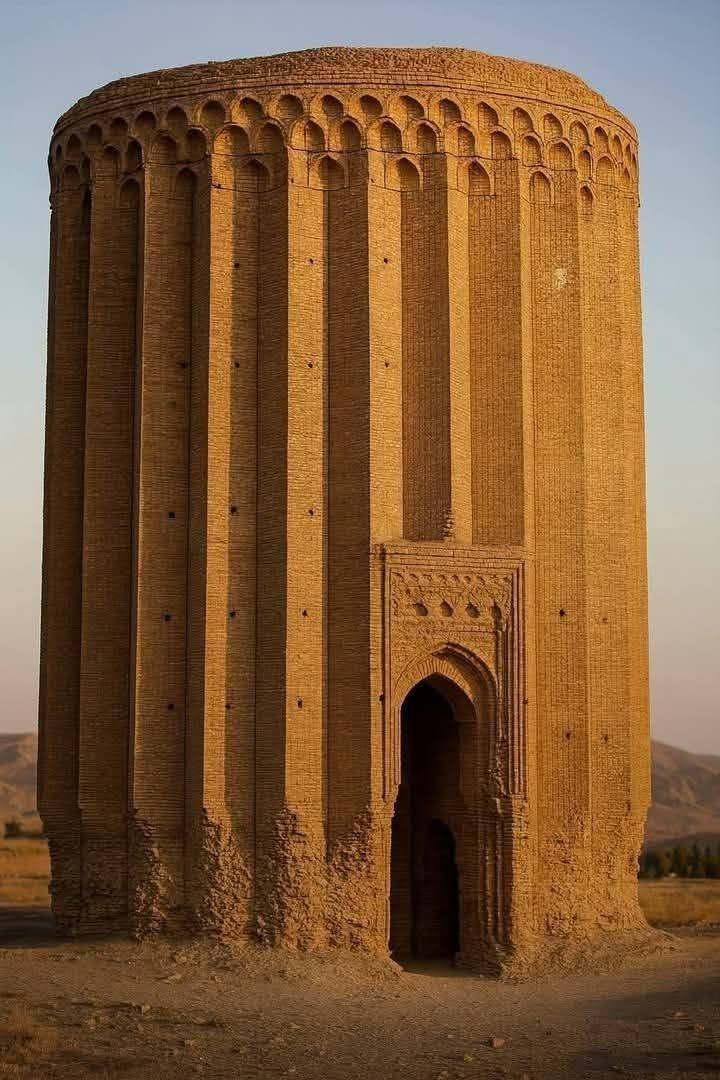
From a material and manufacturing perspective, the tower is constructed entirely of fine-quality, unglazed fired yellow-brown bricks, which have weathered into a rich golden hue over the centuries. Standing at a staggering height of 72 meters (including its conical roof), the structure features a cylindrical shaft that tapers slightly upward, punctuated by ten evenly spaced triangular ʙuттresses or flanges. The builders achieved this architectural marvel without internal support columns or floors, utilizing sophisticated geometric planning and precise bricklaying techniques where the structural material itself serves as the primary decoration.

Functionally and symbolically, the tower was commissioned as a mausoleum for the Ziyarid prince, ruler, poet, and patron of science, Qabus ibn Wushmgir. Beyond its practical sepulchral function, the towering structure served as a monumental statement of princely power, political authority, and cosmic longevity, designed to project eternal glory far beyond the mortal ruler’s lifetime. Its soaring verticality and precise mathematical proportions reflect the sophisticated integration of Islamic funerary architecture with pre-Islamic memorial traditions of the Caspian region.
The historical documentation, architectural analysis, and global preservation of the Gonbad-e Qabus Tower have been advanced through generations of international scholars, epigraphers, and heritage organizations, leading to its official inscription as a UNESCO World Heritage Site in 2012. Pioneering architectural historians and organizations have continuously studied its seismic resilience and unique structural engineering, ensuring that this pre-Mongol masterpiece remains protected against environmental degradation. Today, the monument stands as an enduring testament to the engineering genius and aesthetic refinement of medieval Persian builders.
✓ Ryan Mitchell
The Gonbad-e Qabus Tower is located on a low artificial mound at the edge of the ancient city of Gorgan in the Golestan Province of northeastern Iran….