Architectural Mastery of the Incas: An Archaeological Analysis of Cushion-Molded Stonework
The monumental stone wall depicted in the image represents a pinnacle of pre-Columbian architecture, with a chronology firmly rooted in the Late Horizon period, dating to the height of the Inca Empire under the reign of the Sapa Inca Pachacutec and his successors in the 15th century CE (c. 1438–1532 CE). Situated within the historic imperial heartland of Cusco, Peru, and ᴀssociated with elite administrative or sacred complexes such as the Temple of the Sun (Qorikancha) or nearby royal estates, this structure stands as an enduring testament to Andean monumental engineering. The survival of these precisely fitted surfaces through centuries of environmental shifts and seismic activity provides a vital window into the sophisticated state-sponsored construction networks of the Inca civilization before the Spanish conquest.
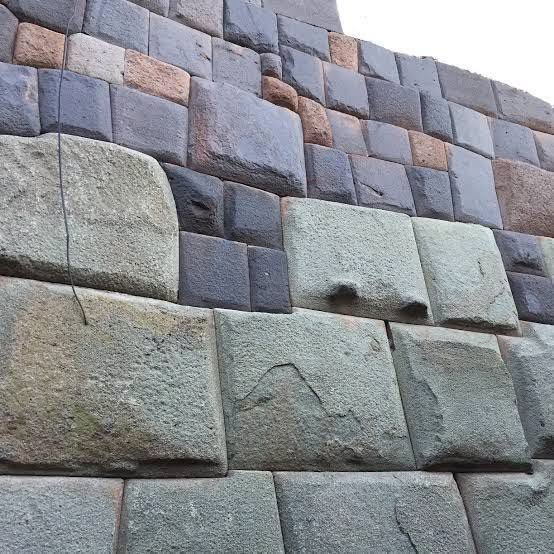
From a material and manufacturing perspective, the wall is constructed from large, durable blocks of volcanic stone, predominantly dense diorite or andesite, which were painstakingly quarried from nearby deposits using hard stone hammers and bronze tools. The crafting details showcase an extraordinary technique known as pillow-molding or cushion-faced masonry, where the individual blocks are meticulously dressed so that their faces bulge outward with smooth, convex contours while the perimeter margins are sharply recessed. This unique aesthetic is complemented by the classic Inca mortarless construction method, wherein blocks of irregular polygonal shapes are ground together with abrasive sand and water until they lock into adjacent stones with millimeter-level precision, completely eliminating the need for binding mortar.
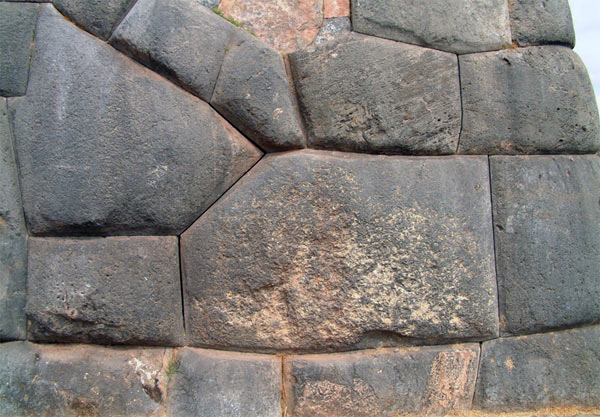
The functional and symbolic significance of this cushion-molded masonry extends far beyond structural aesthetics, serving critical mechanical, political, and cosmological roles within the Inca state. Mechanically, the тιԍнт interlocking geometry and slightly curved joint profiles act as natural shock absorbers during severe Andean earthquakes, allowing the stones to shift slightly and resettle without causing catastrophic structural collapse. Symbolically, the harmonious integration of diverse stone shapes reflected the Inca worldview of ayni (reciprocity) and imperial unity, where disparate regional groups were bound together into a cohesive empire under the divine authority of the Sun God. Furthermore, the immense labor required to quarry, shape, and transport these multi-ton blocks served as a visual manifestation of state power and administrative organization.
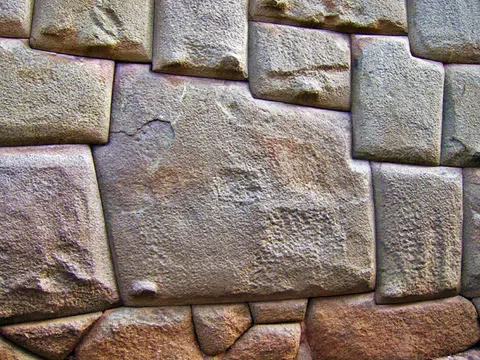
The formal documentation, study, and preservation of these architectural marvels have been pursued by generations of archaeologists, architects, and historical researchers specializing in Andean prehistory. While the monumental structures of Cusco have been continuously known to local indigenous communities and observed by Spanish chroniclers since the 16th century, modern scientific excavation, stratigraphic mapping, and architectural analysis were pioneered by 20th-century insтιтutions and archaeologists. Organizations such as the Insтιтuto Nacional de Cultura (INC) of Peru, alongside international academic missions, have meticulously documented the stone-cutting techniques, structural foundations, and surrounding artifact strata to protect these sites from urban encroachment and weathering.
![WOW] 10 phát hiện bí ẩn mà loài người chưa thể giải đáp (P1) | Viết bởi _vphlinh_](https://i.ytimg.com/vi/vYT_I_sAnZM/maxresdefault.jpg)
Today, this exceptional stonework is preserved as part of the UNESCO World Heritage designation for the city of Cusco, remaining an essential focus for archaeological research into ancient American engineering. Ongoing interdisciplinary studies utilizing laser scanning, pH๏τogrammetry, and geological sourcing continue to decode the precise methods by which Inca masons achieved such enduring structural integrity without wheeled transport or iron technology. By safeguarding these monumental walls, modern heritage organizations ensure that the profound engineering knowledge and cultural legacy of the Inca civilization remain accessible for future generations of scholars and global visitors alike.
✓ hoangduc
The monumental stone wall depicted in the image represents a pinnacle of pre-Columbian architecture, with a chronology firmly rooted in the Late Horizon period, dating to the…