Christa Pike Survived Tennessee’s Failed Execution — Now Her Lawyers Are Raising New Health Concerns
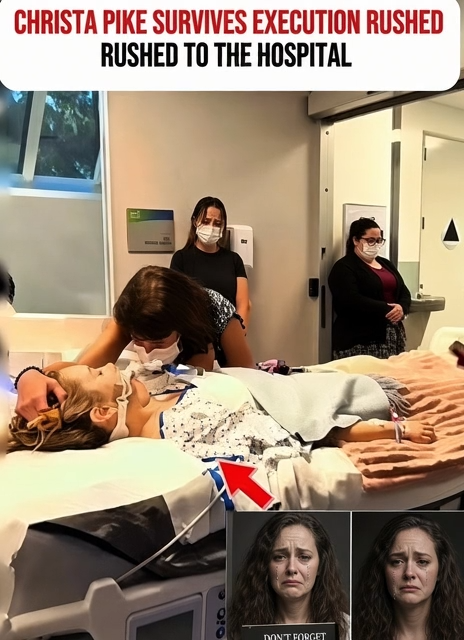
🚨 TENNESSEE’S FAILED EXECUTION LEFT CHRISTA PIKE FIGHTING TO RECOVER — NOW HER LAWYERS ARE WARNING ABOUT POSSIBLE LASTING HARM
After surviving two doses of lethal-injection drugs, Christa Pike faces an uncertain recovery. Her attorneys are raising serious questions about her physical injuries, cognitive difficulties, and what happened inside Tennessee’s execution chamber. Could the failed procedure change the legal battle over her death sentence?
The attempted execution of Christa Pike was supposed to bring a decades-old criminal case to its final chapter. Instead, what happened on September 30, 2026, has triggered urgent questions about medical care, prison procedures, accountability, and the future of capital punishment in Tennessee.
Pike, 50, survived the state’s attempt to execute her by lethal injection at Riverbend Maximum Security Insтιтution in Nashville. She received two doses of pentobarbital, the drug used in the procedure, but she did not die. Instead, she was taken for emergency medical treatment in a condition that her attorneys later described as critical.
Now, her legal team says the consequences extend beyond the failed procedure itself. While Pike has made progress in her recovery, her lawyers have reported continuing cognitive concerns and uncertainty about whether she will experience lasting effects. The questions surrounding her condition have become central to a broader legal fight over what happened that night. (The Washington Post)
A Failed Execution With Serious Medical Consequences
On September 30, Tennessee officials began carrying out Pike’s scheduled execution for the 1995 murder of 19-year-old Colleen Slemmer, a fellow student at the Knoxville Job Corps program.
The procedure did not go as planned.
According to court filings from Pike’s attorneys, problems arose with the intravenous lines used to administer the drug. Her lawyers alleged that the execution team failed to recognize that the lines were not properly placed and that the medication may have entered surrounding tissue rather than being delivered as intended.
Those claims have raised serious questions about the execution team’s actions and whether the state followed its own procedures. The full circumstances remain subject to investigation, and the allegations made by Pike’s attorneys should not be confused with final findings by investigators or a court.
In the aftermath, Pike was hospitalized and placed on a ventilator. Her legal team reported severe swelling, burns, and blistering on her arms. At one point, her condition appeared so dire that her attorneys believed she might not survive.
Then came an unexpected development.
Her Recovery Surprised Even Her Own Legal Team
On October 6, Pike’s attorneys announced that she had regained consciousness and was speaking. The news came after days of grave concern about her condition.
Her recovery, however, did not mean that the medical crisis was over.
In statements reported by news organizations, her lawyers described confusion and cognitive difficulties, alongside physical problems that initially affected her ability to eat, swallow, and move her arms. They also reported complications including pneumonia and a blood clot.
As the days pᴀssed, her attorneys reported signs of improvement. Pike began eating again, took limited steps with ᴀssistance, and showed progress in the movement and strength of her arms and hands.
But the long-term outlook remained uncertain. Her lawyers said it could take months to ᴀssess whether she would experience lasting cognitive impairment. Those concerns are especially significant because recovery from a critical medical event cannot be judged solely by whether a patient regains consciousness or can perform basic physical activities.
The distinction matters: Pike’s reported progress is encouraging, but it does not establish that she has fully recovered. Her legal team has continued to monitor her condition and raise concerns about the lasting consequences of the failed execution. (ABC News)
Why Her Lawyers Want Answers
For Pike’s attorneys, the immediate priority is her continued medical care. But they are also seeking answers about how the execution was conducted and what went wrong.
Their concerns include the placement of the IV lines, the administration of the drugs, the injuries Pike sustained, and the records that could help establish a precise timeline of events.
A Tennessee judge has ordered state officials to preserve evidence connected to the September 30 procedure. The order covers physical items and records that may be relevant to determining what occurred, including syringes, IV equipment, pH๏τographs, recordings, communications, and documentation of complications.
Preserving that evidence could prove crucial. Without reliable records, investigators and the courts may have difficulty reconstructing the procedure and evaluating competing accounts of what happened.
The case has also drawn additional scrutiny after the release of emergency-call recordings. Reporting by The Washington Post described confusion among dispatchers and prison personnel that delayed emergency medical ᴀssistance for more than 30 minutes. According to the report, Pike’s attorney contacted emergency services directly to stress that Pike remained alive and needed urgent treatment.
Those details have intensified questions about the response to the failed execution. They also raise a fundamental issue: when a state-administered procedure fails in a potentially life-threatening way, how quickly and effectively must officials respond?
(The Washington Post’s report on the emergency calls)
Pike Has Returned to Prison, but Her Recovery Continues
On October 10, Pike was discharged from the hospital and returned to the Debra K. Johnson Rehabilitation Center in Nashville, where she had been incarcerated for decades.
Her attorneys said she would continue receiving medical care at the prison and that they would keep monitoring her recovery. Her discharge did not resolve the questions about possible long-term effects, nor did it settle the legal disputes arising from the failed execution.
The return to prison also places renewed attention on what medical support she will receive, how her condition will be ᴀssessed, and whether further treatment will be necessary as her recovery progresses.
At this stage, the available public information does not establish the full extent of any lasting injury. It is therefore important not to treat the most serious possible outcomes as certain. Her lawyers have expressed concern, but the long-term medical picture remains unresolved.
Could the Failed Execution Change Her Legal Future?
The incident has transformed the debate over Pike’s case. Her attorneys have argued that the experience she endured should carry significant legal consequences, including renewed consideration of whether her death sentence should be commuted.
Tennessee Governor Bill Lee has suspended scheduled executions for the remainder of 2026 and ordered an independent review of the failed procedure. The state’s response, the findings of that review, and any future court decisions could influence the next steps in the case.
But major questions remain unanswered. Investigators must determine why the procedure failed. Medical professionals must continue evaluating Pike’s recovery. And courts may eventually have to consider the legal implications of an execution attempt that left the person scheduled to die alive but seriously injured.
There is no confirmed outcome establishing that Pike’s sentence will be changed or that another execution attempt will take place. Her legal future remains uncertain.
A Case With Consequences Beyond One Prison
The controversy surrounding Pike’s failed execution reaches beyond her individual case. It has renewed debate about the reliability of lethal injection, the responsibilities of correctional officials, emergency medical responses, and the limits of state power when an execution does not proceed as intended.
For supporters of the death penalty, the incident raises questions about whether the state can carry out executions reliably and according to established procedures. For opponents, it has become a stark example of the potential consequences when a lethal procedure goes wrong.
The case also carries a human dimension that should not be lost in the legal and political arguments. Colleen Slemmer was 19 when she was murdered in 1995, and her family has lived with that loss for decades. Any discussion of Pike’s future must acknowledge the gravity of the original crime while also examining the state’s obligations during an execution.
For now, the most important facts are clear: Pike survived the September 30 attempt, suffered serious reported injuries, regained consciousness, and returned to prison for continued care. Her lawyers remain concerned about her cognitive recovery and the possibility of lasting harm. The investigation into the failed procedure continues to carry significant consequences for Tennessee.
What happens next may depend on what investigators discover, what further medical evaluations reveal, and how the courts respond to the unprecedented circumstances.
Could the injuries and uncertainty surrounding Pike’s recovery reshape the legal fight over her sentence? That question remains open, and the answers may have implications far beyond this one case.
This article reflects publicly reported information and statements attributed to Pike’s attorneys. The full medical prognosis and the final findings of the investigation have not been established.
✓ Team
🚨 TENNESSEE’S FAILED EXECUTION LEFT CHRISTA PIKE FIGHTING TO RECOVER — NOW HER LAWYERS ARE WARNING ABOUT POSSIBLE LASTING HARM After surviving two doses of lethal-injection drugs,…