Decoding the Stratigraphy and Iconography of Newspaper Rock: A Monumental Petroglyph Panel in Southeastern Utah
Newspaper Rock, known traditionally by the Indigenous Native American peoples as Tsaa’ Asdasaa (meaning “rock that is written on”), stands as one of the most remarkable and visually dense open-air archaeological sites in the North American Southwest. From an archaeological perspective, this site functions as a vertical historical archive, preserving overlapping layers of petroglyphs created over thousands of years. Located along Indian Creek in San Juan County, southeastern Utah, along the highway leading toward the Needles district of Canyonlands National Park, the site occupies a towering, smooth vertical face of Wingate Sandstone measuring approximately 200 feet long and 30 feet high. The dark, reddish-brown to black patina adorning the cliff face—commonly referred to as “desert varnish” or rock varnish—provided an ideal canvas for ancient and historic carvers, who meticulously pecked away the outer manganese and iron oxide coating to reveal the lighter, contrasting tan and orange sandstone underneath.
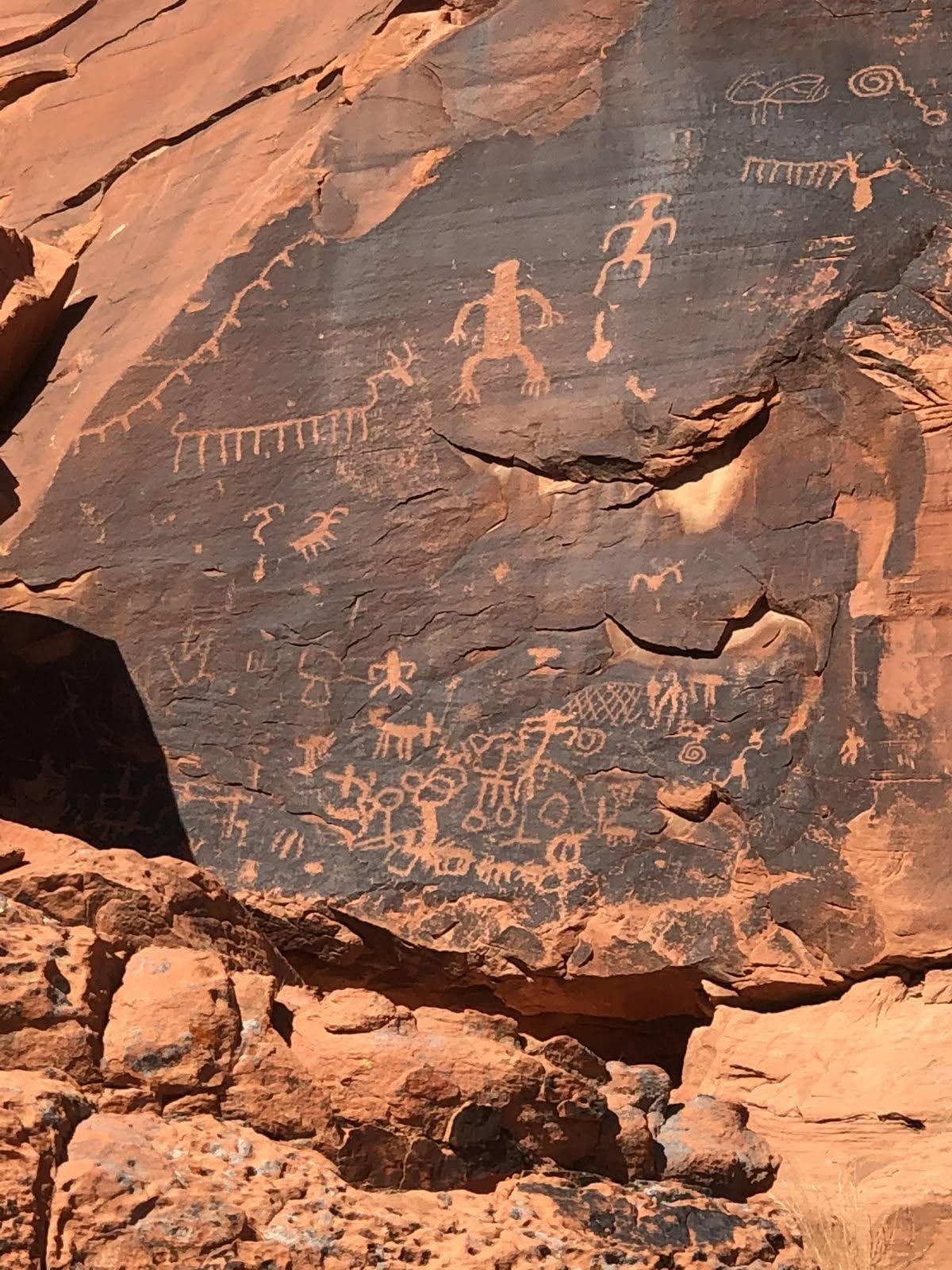
Chronologically, the rock art panel represents a palimpsest of multiple cultural periods, with initial carvings dating back approximately 2,000 years to the late Archaic period, continuing extensively through the Basketmaker II and III phases, the Puebloan (Anasazi) era spanning from roughly 500 B.C. to A.D. 1350, and culminating in historic-era additions by the Ute and Euro-American travelers. The earliest stratigraphic layers are heavily patened, dark, and deeply weathered, making them blend back into the surrounding rock face, whereas subsequent cultural additions display progressively lighter patination and sharper chisel marks. This chronological depth allows archaeologists to trace stylistic evolution across distinct cultural traditions, tracking how succeeding generations interacted with the exact same sacred geological formation. The meticulous documentation of these overlapping styles offers crucial relative-dating benchmarks for regional rock art studies across the Colorado Plateau.

In terms of material composition and manufacturing techniques, the petroglyphs were produced entirely through direct and indirect percussion methods. The artisans utilized hard stone hammerstones, percussion flakes, and occasionally chisel-like quartz or chert implements to fracture the brittle desert varnish without shattering the underlying sandstone matrix. The iconography is extraordinarily diverse, featuring a complex array of anthropomorphic figures with elaborate headdresses, zoomorphic representations including bighorn sheep, bison, deer, and canine-like predators, alongside distinct geometric symbols, handprints, tracks, and abstract motifs. Particularly notable are the shield-bearing warriors and anthropomorphs characteristic of the Fremont and Ancestral Puebloan traditions, which demonstrate a high degree of craftsmanship, spatial coordination, and deliberate compositional layout across the undulating stone surface.

The functional interpretation and cultural significance of Newspaper Rock extend far beyond simple artistic expression, embodying deep spiritual, cosmological, and territorial meanings for Indigenous populations. Archaeologists and ethnographers suggest that the panel served as a sacred communal bulletin board, a ceremonial ritual site, or a liminal space where traveling hunting parties, spiritual leaders, and clan groups recorded significant events, visions, tribal migrations, and successful hunts. The high concentration of bighorn sheep motifs points to ritual sympathetic magic aimed at ensuring successful game harvest, while cosmological symbols and anthropomorphic deities reflect deep-seated religious mythologies concerning creation, emergence, and the spirit world. Furthermore, the continuity of carvings across successive millennia emphasizes the enduring sacred geography of the canyon, where each new culture acknowledged and added to the spiritual legacy of their predecessors.
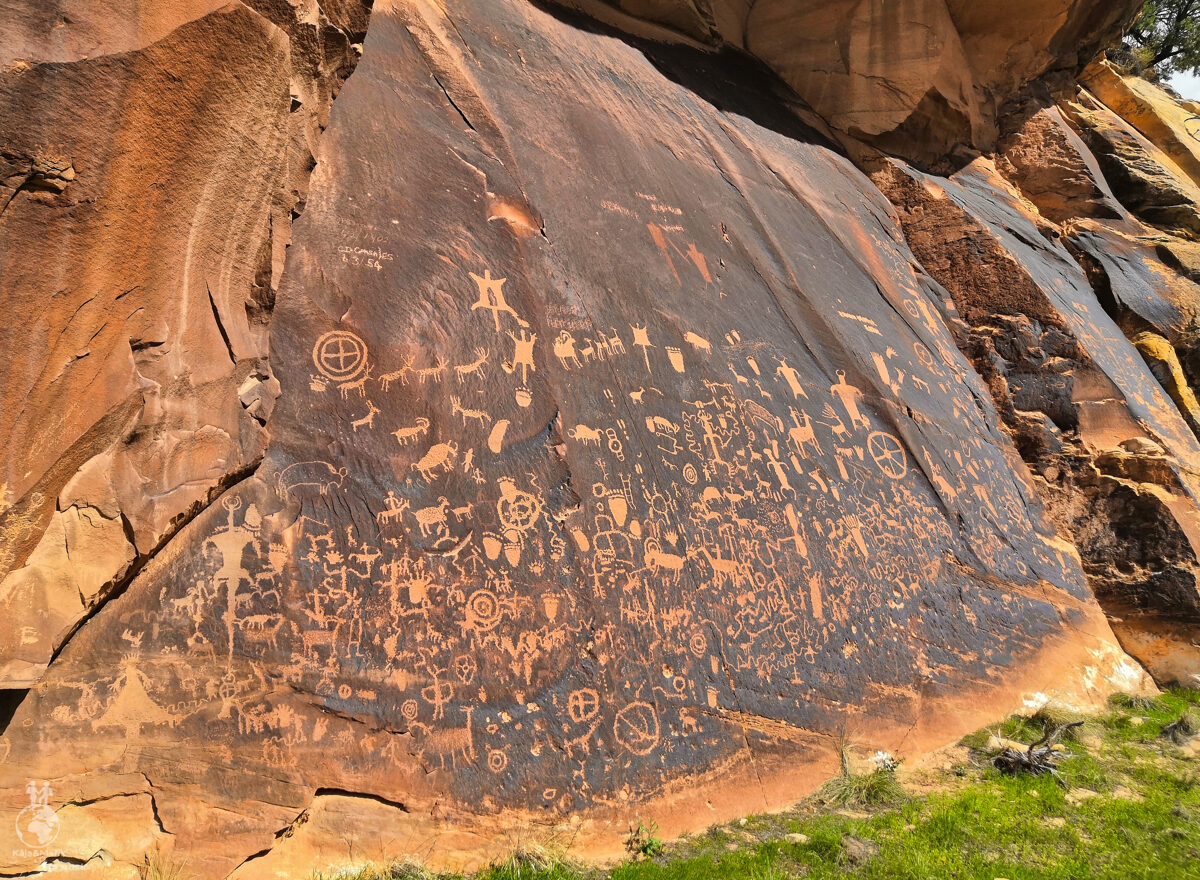
From the perspective of insтιтutional discovery and preservation, Newspaper Rock was brought to the attention of modern American archaeology and the general public during the mid-to-late 19th century as westward expansion and cattle ranching brought settlers into the Indian Creek corridor. Recognizing its immense cultural and archaeological value, the federal government officially protected the site by placing it under the administration of the Bureau of Land Management (BLM), which later designated it as a historic site and erected protective fencing, interpretive boardwalks, and informational kiosks to safeguard the fragile petroglyphs from vandalism and visitor erosion. Today, professional archaeologists, conservators, and tribal descendants continue to collaborate on non-invasive documentation techniques—such as digital pH๏τogrammetry and laser scanning—to monitor weathering patterns and preserve this irreplaceable monument of prehistoric American Indian heritage for future scientific study.
✓ hoangduc
Newspaper Rock, known traditionally by the Indigenous Native American peoples as Tsaa’ Asdasaa (meaning “rock that is written on”), stands as one of the most remarkable and…