⚡ DR. STEVEN GREER MAKES A BOLD CLAIM — Has Revolutionary Energy Technology Been Hidden for Decades?

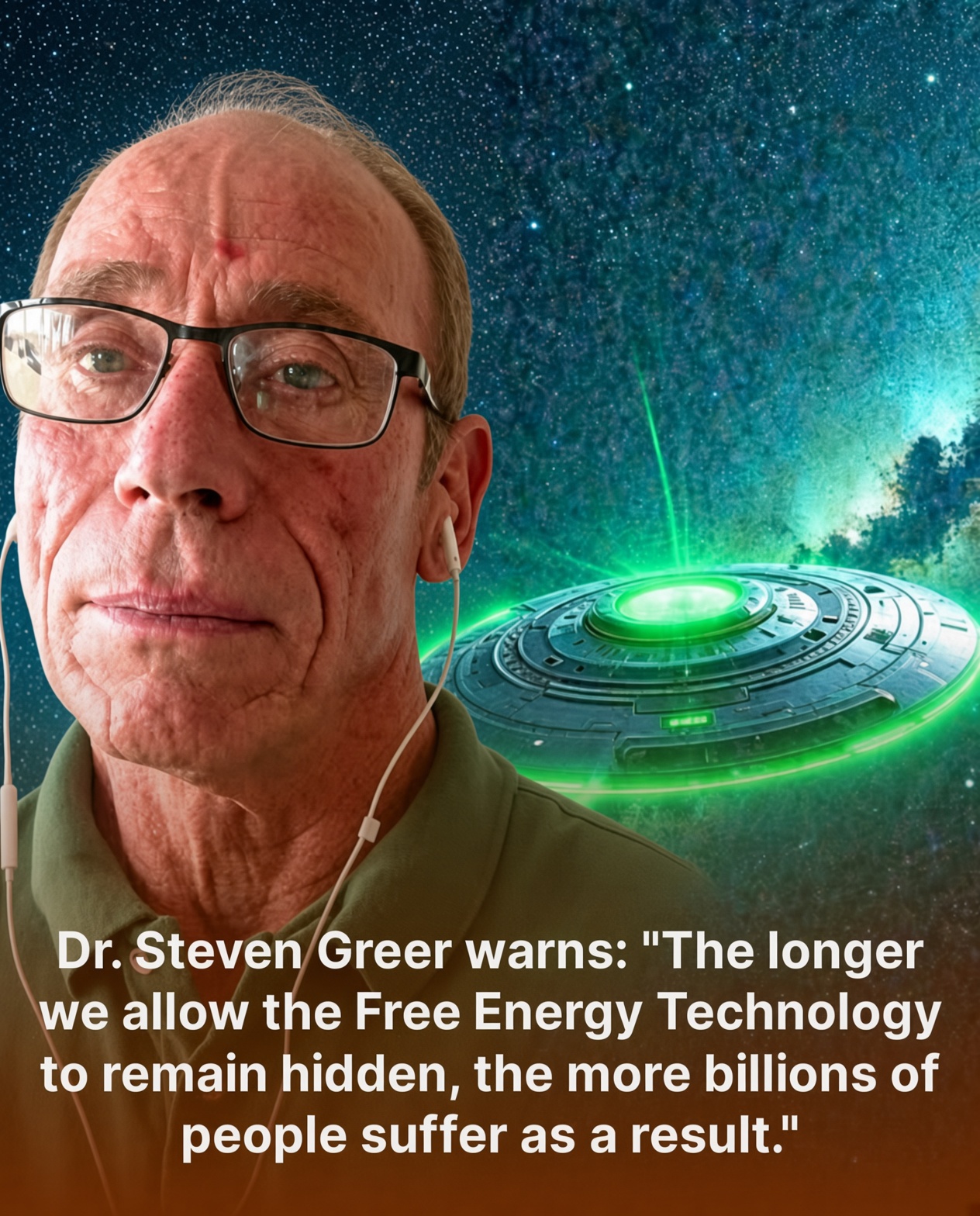
THE HIDDEN ENERGY TECHNOLOGIES DR. STEVEN GREER SAYS COULD CHANGE THE WORLD
For decades, Dr. Steven Greer has made one of the most controversial claims in the modern discussion surrounding advanced technology, government secrecy, and unidentified phenomena: humanity may already possess energy technologies capable of fundamentally transforming the global power system, yet those technologies have allegedly been kept out of public reach.
Greer’s argument is not simply that governments have classified individual inventions or that corporations have protected profitable technologies. His claim goes much further.
He has suggested that highly advanced, potentially revolutionary energy systems have been suppressed for roughly a century — technologies that, if openly developed and deployed, could dramatically change how humanity produces, distributes, and consumes energy.
At the center of his argument is a troubling question:
What if some of the biggest energy challenges facing humanity are not problems we lack the ability to solve, but problems we have been prevented from solving?
That premise is extraordinary. And it remains deeply contested.
🌍 THE ENERGY PROBLEM BEHIND THE CLAIM
Modern civilization depends heavily on energy.
Electricity powers hospitals, transportation networks, factories, communications systems, homes, farms, data centers, and virtually every aspect of modern life. Yet access to reliable and affordable energy remains unequal around the world.
At the same time, humanity faces major environmental challenges.
Fossil fuels continue to play a significant role in global energy production, while concerns about greenhouse-gas emissions, air pollution, climate change, resource consumption, and energy security have intensified.
Solar, wind, hydropower, nuclear energy, batteries, geothermal systems, and other technologies have expanded dramatically.
But Greer argues that these technologies, while useful, do not represent the full technological potential available to humanity.
He believes something much more advanced may exist.
⚡ THE “SPACE AGE HIGH-TECH” IDEA
Greer has repeatedly described what he calls “space age high tech” — advanced systems that he argues could provide enormous amounts of energy without relying on conventional fuel sources.
The exact mechanisms he has discussed over the years vary, and many of his broader claims connect energy technology with his views about extraterrestrial intelligence and unidentified aerial phenomena.
His argument essentially suggests that some technological breakthroughs attributed to classified research, alleged recovered objects, or unconventional scientific discoveries could potentially have enormous implications for energy production.
Imagine a world where electricity could be generated through a fundamentally different mechanism — one that required dramatically fewer conventional resources and produced little or no pollution.
The consequences would extend far beyond the power grid.
Transportation could change.
Manufacturing could change.
Agriculture could change.
Water desalination could become more accessible.
Remote communities could gain reliable electricity.
Countries heavily dependent on imported fuels could become more energy independent.
And entire industries built around extracting, transporting, refining, and selling conventional fuels could be transformed.
That is the scale of the possibility Greer is pointing toward.
But possibility is not proof.
🏭 WHY WOULD SUCH TECHNOLOGY BE SUPPRESSED?
This is where Greer’s argument becomes particularly controversial.
He has suggested that powerful economic and insтιтutional interests could have strong incentives to prevent disruptive energy technologies from reaching the open market.
The reasoning is straightforward on the surface.
Energy is one of the world’s largest industries.
Oil, natural gas, coal, electricity generation, transportation, infrastructure, and related industries involve enormous investments and economic interests.
A technology capable of producing abundant energy at extremely low cost could potentially disrupt established markets.
From this perspective, Greer’s supporters ask:
Would industries built around scarce and expensive energy willingly allow a technology that could make their existing business models obsolete?
It is a compelling question.
But asking the question is not the same as establishing that suppression actually occurred.
And this distinction is crucial.
🔬 WHERE DOES THE EVIDENCE STAND?
Despite the extraordinary nature of Greer’s claims, no independently verified evidence has established that a revolutionary energy technology capable of replacing conventional global energy systems has been deliberately suppressed for a century.
There is no publicly verified device that has demonstrated such capabilities under controlled scientific conditions.
There is also no established body of reproducible experimental evidence proving that governments or private interests possess a hidden technology capable of solving the world’s energy problems on the scale described.
That does not automatically prove that every unconventional energy concept is impossible.
Science has repeatedly demonstrated that today’s ᴀssumptions can be challenged by tomorrow’s discoveries.
But extraordinary claims require extraordinary evidence.
A technology that could transform the global energy system would need to withstand rigorous testing, independent replication, engineering analysis, and scientific scrutiny.
Without that evidence, the claims remain allegations and hypotheses rather than established facts.
🧠 THE CONNECTION TO LOST KNOWLEDGE
Interestingly, the debate surrounding Greer’s claims connects with a much older human fascination: the possibility that knowledge can disappear.
History provides genuine examples of technologies, techniques, and cultural knowledge being lost or forgotten.
Ancient civilizations developed sophisticated methods in metallurgy, construction, astronomy, agriculture, navigation, medicine, and engineering. Some techniques survived through written records and traditions. Others disappeared and had to be rediscovered or reconstructed centuries later.
That raises a fascinating question:
How much human knowledge has been lost throughout history?
And perhaps an even more intriguing one:
Could humanity someday rediscover technologies that were once understood but later forgotten?
These questions are legitimate areas of historical and scientific inquiry.
However, there is an important difference between lost knowledge and deliberately suppressed revolutionary technology.
The first has abundant historical examples.
The second requires specific evidence.
🌌 WHAT IF WE ARE MISSING SOMETHING?
This is ultimately why discussions surrounding Greer’s claims continue to attract attention.
Even people who reject his conclusions can still engage with the underlying question.
Human technological progress has never been perfectly linear.
Ideas that once seemed impossible have eventually become ordinary.
Flight was once considered unrealistic.
Global communication across oceans once required extraordinary infrastructure.
Nuclear energy transformed our understanding of what could be extracted from matter.
Modern computing would have appeared almost unimaginable to earlier generations.
Artificial intelligence is now developing at a speed that would have seemed like science fiction only decades ago.
So it is reasonable to ask what technologies might exist decades or centuries from now.
But there is a critical difference between remaining open to new possibilities and accepting an extraordinary claim without sufficient evidence.
Curiosity requires imagination.
Science requires verification.
Both can exist at the same time.
🔎 THE BIGGER QUESTION
Perhaps the most interesting part of this debate isn’t whether one particular claim is ultimately correct.
It is the broader question of how humanity handles transformative discoveries.
Who decides which technologies receive funding?
How much research remains classified?
How do governments balance national security with public transparency?
How much influence do economic incentives have over technological development?
And when a potentially revolutionary invention appears, who determines whether it reaches the public?
These are real questions — even without accepting claims about hidden energy machines.
The history of science and technology is filled with discoveries shaped by governments, universities, corporations, military organizations, investors, and individual researchers.
Understanding those relationships is important because the technologies developed today could determine the energy systems of tomorrow.
🌍 A FUTURE STILL WAITING TO BE DISCOVERED
Dr. Steven Greer’s vision is dramatic: a world where advanced energy technologies could potentially provide abundant power, reduce environmental pressures, and dramatically change global society.
Whether such hidden technologies actually exist remains unproven.
There is currently no verified evidence demonstrating that a century-long suppression of revolutionary energy systems has occurred.
But the underlying challenge is real.
Humanity needs cleaner, more affordable, more reliable, and more widely accessible energy.
Researchers around the world are already pursuing breakthroughs in nuclear fusion, advanced batteries, solar technology, geothermal power, energy storage, nuclear fission, materials science, and other fields.
Perhaps the future will come from an unexpected discovery.
Perhaps it will emerge from improving technologies we already understand.
Or perhaps an entirely new scientific breakthrough will eventually change the way we think about energy itself.
For now, Greer’s claims remain controversial and unverified.
But they leave us with a question that is difficult to ignore:
Are we already closer to an energy revolution than we realize — or are we still waiting for the breakthrough that will finally change everything?
The evidence has yet to provide a definitive answer.
And until it does, the most responsible approach may be to remain curious, examine extraordinary claims carefully, demand verifiable evidence, and never stop asking what humanity might still discover.
✓ Team
THE HIDDEN ENERGY TECHNOLOGIES DR. STEVEN GREER SAYS COULD CHANGE THE WORLD For decades, Dr. Steven Greer has made one of the most controversial claims in the…