Echoes in the Desert: The Geoglyphs of the Nazca Ridge
The vast, arid plateau of the Rio Grande de Nazca river basin in southern Peru home to one of the most enigmatic archaeological wonders of the world: the Nazca Lines. Specifically, the mᴀssive trapezoidal and rectangular “runways” visible on the mountain ridges, as seen in the provided image, belong to a cultural tradition that flourished between 500 BCE and 500 CE. These features are part of the larger Nazca Palpa archaeological complex, a UNESCO World Heritage site since 1994. While often overshadowed by the famous zoomorphic figures like the hummingbird or the spider, these sprawling geometric geoglyphs represent a monumental phase of Andean pre-history, reflecting the sophisticated social organization and spiritual complexity of the Nazca people during the Early Intermediate Period.
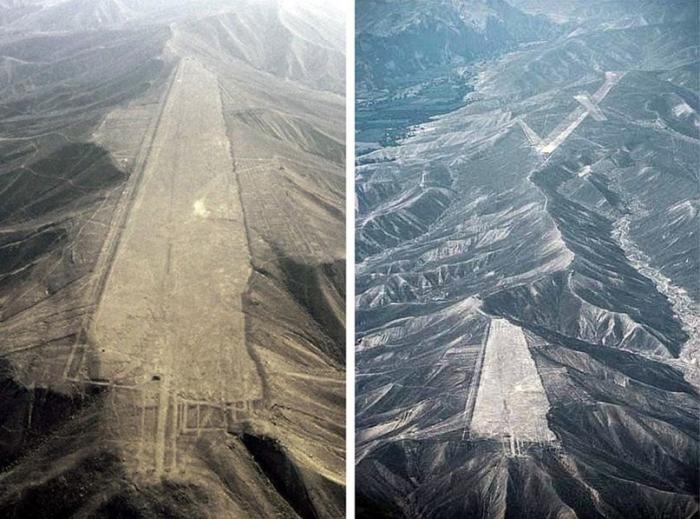
The fabrication of these geoglyphs is a masterclass in subtractive landscape engineering, utilizing the unique geological conditions of the Peruvian pampa. The desert floor is covered in a thin layer of dark, iron-oxide coated pebbles (desert varnish); by removing this top layer, the Nazca people exposed the lighter-colored subsoil—a mixture of sand, clay, and gypsum—underneath. This contrast creates a striking visual effect that has remained preserved for nearly two millennia due to the region’s extreme aridity and lack of wind-driven erosion. For the mᴀssive trapezoids and straight lines found on ridgelines, researchers believe the Nazca used simple surveying tools, such as stakes and ropes, to establish perfectly straight borders over several kilometers, demonstrating a profound understanding of geometry and large-scale spatial planning.

In the realm of archaeological interpretation, the function of these geometric “runways” has evolved far beyond early pseudoscientific theories of alien contact. Modern consensus suggests they served as ritual spaces for communal gatherings and religious ceremonies. These flat, cleared areas were likely “processional paths” where the community would walk in single file or gather in large groups as part of water and fertility cults. Given the extreme scarcity of water in the Nazca desert, these lines often align with underground aquifers or point toward distant mountains where rain-bearing clouds were believed to originate. The trapezoids, in particular, acted as open-air stages for offerings, where shattered ceramic vessels have been discovered, indicating they were sites of intensive ritual activity aimed at appeasing deities responsible for life-sustaining water.

The academic discovery and systematic study of these lines were propelled by the work of American historian Paul Kosok in 1940 and, most famously, by the German mathematician and archaeologist Maria Reiche. Reiche, often called the “Lady of the Lines,” spent over 50 years living in the desert, meticulously mapping the geoglyphs and advocating for their preservation. In more recent decades, the Nazca-Palpa Project, led by Johny Isla of Peru and Markus Reindel of the German Archaeological Insтιтute, has utilized modern satellite imagery, drone pH๏τogrammetry, and stratigraphic excavations to provide a more holistic view of the site. Their work has successfully linked the lines to nearby settlement patterns, proving that the geoglyphs were not isolated anomalies but an integral part of the Nazca people’s daily lived experience and agricultural management.

The Nazca ridgeline geoglyphs remain a poignant testament to human resilience and the desire to communicate with the divine through the landscape itself. These “earth-drawings” bridge the gap between the mundane survival of an agrarian society and the lofty aspirations of their spiritual world. While time and modern development pose threats to these fragile markings, ongoing conservation efforts by the Peruvian Ministry of Culture and international heritage organizations continue to safeguard the site. By studying these lines, we gain invaluable insights into how ancient societies perceived their environment—not as a resource to be conquered, but as a sacred canvas upon which their prayers for rain, life, and continuity could be written for the gods to see from the heavens.
✓ hoangduc
The vast, arid plateau of the Rio Grande de Nazca river basin in southern Peru home to one of the most enigmatic archaeological wonders of the world:…