Echoes of the Green Sahara: The Archaeological Significance of the Dabous Giraffe Petroglyphs
The archaeological site of these magnificent rock-cut engravings is located in the remote and arid expanse of the Sahara Desert, most notably exemplified by the Dabous site in the Aïr Mountains of northern Niger. Situated within a vast desert landscape that was once a lush, savannah-like environment during the African Humid Period, these petroglyphs are carved directly onto mᴀssive, wind-polished sandstone outcrops. The context of their discovery reveals a prehistoric landscape densely inhabited by early pastoralists and hunter-gatherers who utilized these elevated rocky terrain formations as canvases. The site was brought to international scientific prominence through systematic geoarchaeological surveys and heritage expeditions conducted in the late 20th century, which aimed to document the rich rock art heritage hidden deep within the Sahara’s transitional zones.
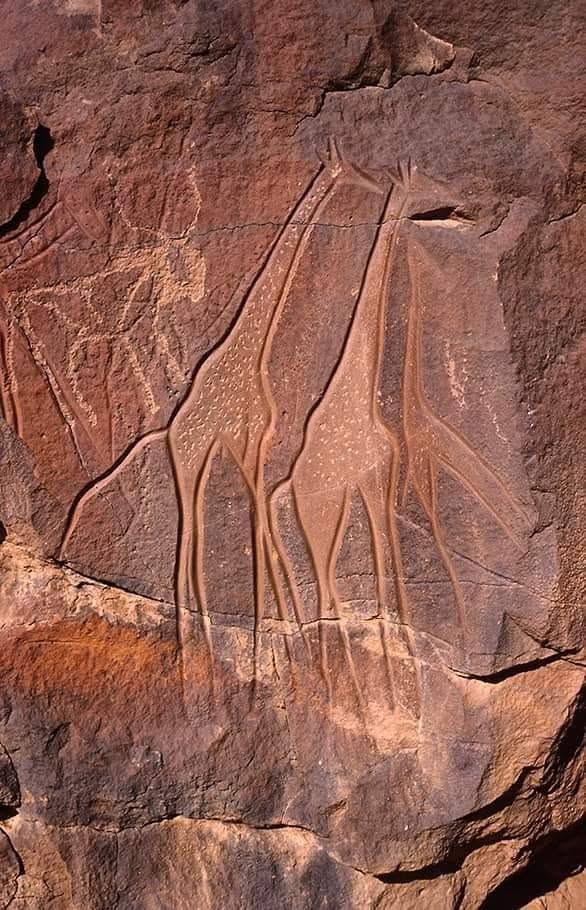
From a material and manufacturing perspective, these life-sized animal carvings are executed on fine-grained, ferruginous sandstone blocks coated with a dark, lustrous layer of desert varnish (patina). The crafting technique required extraordinary skill and patience, utilizing direct percussion and incising methods with hard stone chisels or flint implements. Ancient artisans painstakingly pecked, scraped, and abraded away the dark surface crust to expose the lighter, contrasting reddish-yellow sandstone underneath, achieving remarkable anatomical accuracy. The panel prominently depicts two monumental, naturalistic giraffes—complete with textured body patterns, slender legs, and graceful necks—alongside smaller ᴀssociated fauna, showcasing an exceptional command of proportion and spatial depth in prehistoric lithic art.

Chronologically, rock art panels of this magnitude and stylistic maturity are typically attributed to the Pastoral Neolithic or Late Stone Age period, generally dating back between 9,000 and 5,000 years before present (circa 7000–3000 BCE), during the climatic optimum of the Holocene. Dating such open-air petroglyphs presents complex scientific challenges because they lack direct organic materials for standard radiocarbon testing. Consequently, researchers employ relative dating methodologies, including analyzing the re-formation rate of the dark desert varnish over the carved grooves, stratigraphic excavations of occupation debris at the base of the rock outcrops, and stylistic cross-referencing with excavated pottery and lithic tool ᴀssemblages from nearby pastoral settlements.
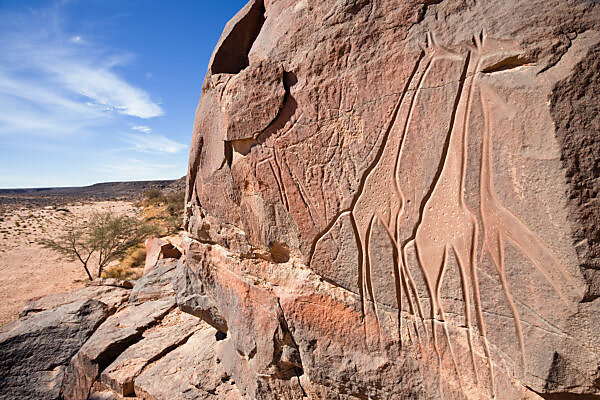
The cultural, ecological, and symbolic significance of these monumental giraffe carvings extends far beyond mere decorative expression, serving as vital windows into ancient paleoenvironments and human ideology. Archaeologists interpret these life-sized depictions not only as reflections of the abundant savannah wildlife that once roamed the region before severe desertification set in, but also as potent symbols of spiritual and ritual importance. The giraffes likely held deep cosmological or totemistic meaning for the pastoralist communities, celebrating fertility, rain magic, or the harmonious coexistence between humans and the vast, formidable fauna of the ancient African wilderness.
The formal documentation, conservation, and scientific study of these fragile prehistoric masterpieces have been spearheaded by dedicated archaeologists, geologists, and cultural heritage organizations. Notably, researchers such as Christian Dupuy and organizations like the Bradshaw Foundation, alongside international academic missions and Niger’s national antiquities authorities, have played pivotal roles in recording and protecting these sites. Utilizing modern non-destructive technologies—such as high-resolution 3D laser scanning, pH๏τogrammetry, and digital molding—these organizations ensure that the intricate details of these monumental carvings are permanently archived and safeguarded against both natural erosion and human encroachment for future generations.
✓ Ryan Mitchell
The archaeological site of these magnificent rock-cut engravings is located in the remote and arid expanse of the Sahara Desert, most notably exemplified by the Dabous site…