Echoes of the Indus: Unveiling the Petroglyphs of Gilgit-Baltistan
The mountainous region of Gilgit-Baltistan, nestled in the northern reaches of Pakistan, serves as an unparalleled open-air museum of human history, where the rugged landscape itself functions as a canvas for ancient civilizations. Among the most remarkable discoveries in this high-alтιтude terrain are the extensive petroglyph sites captured which showcase intricate rock art etched directly into the dark, weather-hardened metamorphic and igneous boulders scattered along the banks of the Indus River. These sites were meticulously documented by various international archaeological expeditions over the past several decades, most notably through the collaborative efforts of the Pak-German Study Group under the leadership of renowned scholars like Karl Jettmar. The sheer density of these engravings, spanning thousands of years, provides a visual narrative of the cultural, religious, and commercial exchanges that once thrived along the ancient Silk Road, turning these barren rocks into vital conduits of historical knowledge.
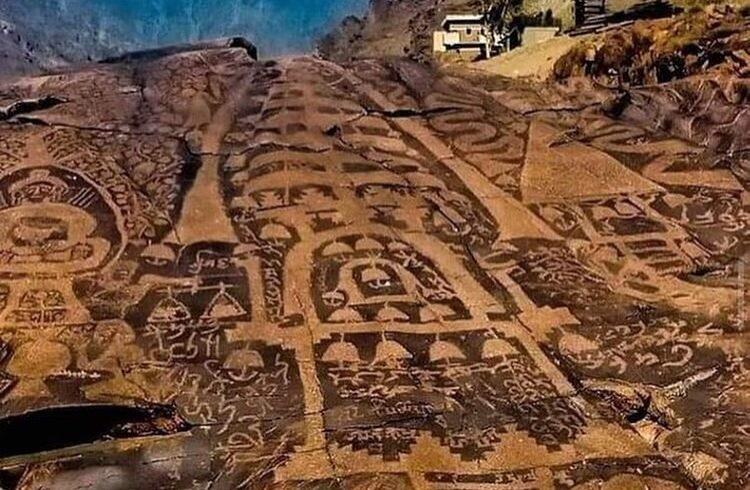
The material and technical execution of these petroglyphs reveal a sophisticated mastery of the lithic medium by prehistoric and proto-historic artisans. The artists selected prominent boulders, often located along trade routes, and employed a technique known as “pecking” or “pounding”—using harder stone chisels to repeatedly strike the darker, desert-varnished surface of the rock to expose the lighter-colored interior. This method allowed for remarkable precision, resulting in detailed depictions of stupas, seated deities, and complex geometric motifs that have managed to survive the harsh climatic conditions of the Karakoram range. The depth and clarity of these carvings suggest that the creators possessed a deep understanding of rock mechanics, ensuring that their symbolic communications would endure against centuries of erosion, wind, and seismic activity.
Chronologically, these rock carvings represent a vast timeline, with the earliest examples dating back to the Neolithic period, while the more sophisticated religious iconography—specifically those featuring stupas and Buddhist imagery depicted—primarily align with the Buddhist transition in the region, roughly spanning from the 1st century BCE to the 10th century CE. During this era, Gilgit-Baltistan emerged as a pivotal crossroads where the Mahayana tradition of Buddhism permeated the local cultural fabric. The inscriptions accompanying these images are often written in Brahmi, Kharosthi, and later, Tibetan scripts, which have allowed modern epigraphers to date the carvings with relative accuracy. This temporal span highlights the region’s long-standing role as a sanctuary for pilgrims and a vital transit point for monks, merchants, and travelers journeying between Central Asia, China, and the Indian subcontinent.
The symbolic meaning and intended function of these petroglyphs extend far beyond simple ornamentation, serving as profound expressions of devotional practice and cultural idenтιтy. The depictions of stupas, suggest that these rocks served as “merit-making” sites, where travelers and pilgrims would carve sacred symbols or sponsor an artist to do so as an act of religious dedication and spiritual protection during their arduous mountain treks. By etching these icons onto the permanent landscape, the ancient inhabitants and travelers effectively sacralized the harsh environment, creating a network of spiritual landmarks that provided both physical navigation and metaphysical reᴀssurance. In a region where nature was both beautiful and unforgiving, these rock carvings acted as enduring prayers, anchoring the transient lives of merchants and monks within the permanent, unyielding geography of the Himalayas and Karakoram.
In conclusion, the archaeological significance of the sites portrayed cannot be overstated, as they represent a bridge between the physical realities of the ancient Silk Road and the profound spiritual dimensions of the societies that walked it. The efforts of researchers like Karl Jettmar and subsequent teams have ensured that these fragile remnants of humanity’s past are recognized as UNESCO World Heritage candidates, requiring urgent attention for their conservation against modern infrastructure development. These engravings are not merely static images on stone; they are vibrant, historical voices that challenge our understanding of ancient communication and mobility. By studying these petroglyphs, we gain crucial insight into how diverse groups of people navigated the challenges of their landscape, leaving behind a permanent record that continues to resonate with contemporary historical inquiry and cultural preservation efforts.
✓ hoangduc
The mountainous region of Gilgit-Baltistan, nestled in the northern reaches of Pakistan, serves as an unparalleled open-air museum of human history, where the rugged landscape itself functions…