GO NOW: Mᴀssive Washington Wildfire Explodes From 200 to 5,000 Acres in Just One Day
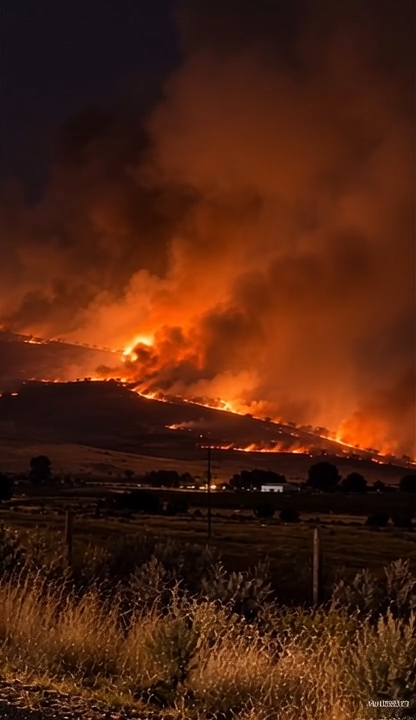
GO NOW EVACUATIONS AS MᴀssIVE WILDFIRE EXPLODES ACROSS WASHINGTON
A fast-moving wildfire has exploded across southeastern Washington, growing at an alarming rate and forcing emergency officials to order Level 3 “GO NOW” evacuations as flames threaten homes, agricultural land, and critical power infrastructure.
The Hatch Grade Fire near Touchet has expanded dramatically, increasing from roughly 200 acres to an estimated 5,000 acres in about a day.
That explosive growth has placed communities in the fire’s path on high alert and triggered a major firefighting response across the region.
The situation remains active, with evacuation zones still in place and firefighters working to slow the fire’s advance.
The fire was last reported at approximately 40% contained, but containment does not mean the danger has disappeared.
With large areas still affected and conditions capable of changing quickly, residents inside evacuation zones are being urged to leave immediately when instructed.
LEVEL 3 “GO NOW” EVACUATIONS
The most urgent warning facing residents is the Level 3 “GO NOW” evacuation order.
This is not a warning to wait and see what happens.
It means people in affected areas should leave immediately when authorities direct them to evacuate.
Wildfires can change direction rapidly, particularly when flames move through dry vegetation and conditions allow the fire to spread quickly.
A delay of even a short period can make evacuation more difficult if roads become congested, smoke reduces visibility, or fire approaches evacuation routes.
Residents who are already under a GO NOW order should prioritize getting themselves and their families to safety rather than attempting to protect property.
People with pets, livestock, medications, important documents, and essential supplies should leave as early as possible when evacuation instructions are issued.
The goal is simple:
Get out before the fire makes escape more dangerous.
A FIRE THAT GREW AT AN EXTRAORDINARY RATE
The growth of the Hatch Grade Fire is one of the most concerning aspects of the emergency.
In approximately one day, the fire reportedly expanded from around 200 acres to roughly 5,000 acres.
That represents an enormous increase in the area affected by the flames.
Such rapid expansion can create a difficult challenge for firefighters.
Crews are not only trying to suppress active flames. They are also working to protect communities, defend infrastructure, establish containment lines, and prevent the fire from spreading into additional areas.
When a wildfire grows this quickly, firefighters may have to prioritize the most immediate threats.
Homes and populated areas can require defensive resources while crews simultaneously work along the fire’s perimeter.
The result is a complex and rapidly changing operation.
HOMES, CROPS AND POWER INFRASTRUCTURE AT RISK
The Hatch Grade Fire is threatening more than just open land.
Homes are among the key concerns as evacuation zones remain in place.
Agricultural areas are also vulnerable, with crops and surrounding farmland potentially exposed to advancing flames and smoke.
Southeastern Washington contains important agricultural communities, meaning a large wildfire can affect not only individual properties but also farms, roads, equipment, utilities, and other infrastructure connected to the local economy.
Power infrastructure is another major concern.
Wildfires can threaten utility corridors and other critical systems, particularly when flames move rapidly across large areas.
Even when infrastructure is not directly damaged, emergency operations and precautionary measures can create disruptions.
For communities already dealing with evacuation orders, the uncertainty can be especially difficult.
Residents may not know when they will be able to return, how far the fire will spread, or whether additional evacuation zones will become necessary.
FIREFIGHTERS MOBILIZED
State firefighting resources have been mobilized as crews work to control the Hatch Grade Fire.
Firefighters are facing the enormous task of slowing a blaze that has already expanded across thousands of acres.
Their work involves attacking the fire where conditions allow, reinforcing containment lines, protecting threatened structures, and monitoring areas where flames could escape established control lines.
Wildfire suppression is rarely a single operation.
Different crews and resources may be ᴀssigned to different sections of a fire depending on where the greatest threats exist.
Some teams may focus on direct fire suppression.
Others may protect homes and infrastructure.
Additional personnel may monitor the perimeter and search for new spot fires.
The overall objective is to prevent the fire from gaining additional ground while improving containment.
40% CONTAINED — BUT STILL ACTIVE
The Hatch Grade Fire was last reported at approximately 40% contained.
That number is important, but it should not be interpreted as meaning the fire is under control everywhere.
Containment refers to the portion of the fire perimeter where firefighters have established lines or other measures intended to prevent further spread.
A fire can be partially contained while still posing a significant threat elsewhere.
That is particularly important in a rapidly developing wildfire emergency.
Even as containment increases, active portions of the fire can continue spreading.
For residents near evacuation zones, the presence of a containment figure should therefore not replace official evacuation instructions.
If authorities say GO NOW, residents should leave.
SMOKE CAN CREATE ADDITIONAL HAZARDS
Even for people outside the immediate fire zone, smoke can become a serious concern.
Large wildfires can send smoke across surrounding communities, reducing visibility and affecting air quality.
Heavy smoke can make driving especially dangerous.
Drivers may have difficulty seeing road markings, other vehicles, intersections, or emergency responders.
Anyone traveling near the affected area should remain alert for changing conditions and follow official road and evacuation information.
People should also avoid entering areas where wildfire smoke is dense unless necessary.
PREPARE BEFORE THE FIRE REACHES YOUR AREA
For residents who remain outside mandatory evacuation zones but live nearby, this is the time to prepare rather than wait for the situation to become critical.
Important documents, medications, chargers, water, essential clothing, and other emergency supplies should be ready to go.
Vehicles should be fueled and positioned so they can leave quickly.
Families should discuss where they will go if an evacuation order expands.
Pet owners should also make arrangements for animals before an emergency evacuation becomes urgent.
Preparation can make a major difference when authorities suddenly issue an evacuation order.
Once smoke becomes heavy or roads become crowded, leaving can become considerably more difficult.
DO NOT WAIT FOR THE FLAMES TO APPEAR
One of the most dangerous mistakes during a wildfire is ᴀssuming there is still plenty of time because flames cannot yet be seen.
Wildfires can move rapidly across open land.
Smoke may arrive before the fire itself.
Road conditions can change.
Evacuation routes can become congested.
And emergency officials may need to change evacuation boundaries as the situation develops.
That is why residents should pay close attention to official alerts and evacuation maps.
If an area moves to Level 3 GO NOW, waiting for visual confirmation of the fire is not a safe strategy.
Leave when instructed.
THE FIRE REMAINS A DEVELOPING EMERGENCY
The Hatch Grade Fire has already demonstrated how quickly conditions can change.
In roughly a day, the reported size jumped from about 200 acres to approximately 5,000 acres.
Level 3 GO NOW evacuations have been ordered in threatened areas.
Homes, crops, and power infrastructure remain concerns.
State firefighting resources have been mobilized.
And while the fire was last reported at around 40% containment, evacuation zones remain in place.
For southeastern Washington communities near Touchet, this is a situation that requires constant attention.
The fire may eventually be brought under control, but until that happens, residents must continue treating the threat seriously.
The safest response to a mandatory evacuation order is not to wait until the last possible moment.
Go when officials tell you to go.
Protect people first.
Property can be replaced.
Lives cannot.
As firefighters continue working to slow the flames and strengthen containment, residents are watching the smoke, monitoring alerts, and hoping the fire’s advance can finally be stopped.
For now, the message remains urgent:
LEVEL 3 — GO NOW.
👇 Are you near Touchet or anywhere affected by the Hatch Grade Fire? What are conditions like in your area right now? Share what you’re seeing — but only if it is safe to do so.
✓ Team
GO NOW EVACUATIONS AS MᴀssIVE WILDFIRE EXPLODES ACROSS WASHINGTON A fast-moving wildfire has exploded across southeastern Washington, growing at an alarming rate and forcing emergency officials to…