Investigating the Parus Rock Monolith: Geological Stratigraphy and Archaeological Context along the Black Sea Coast
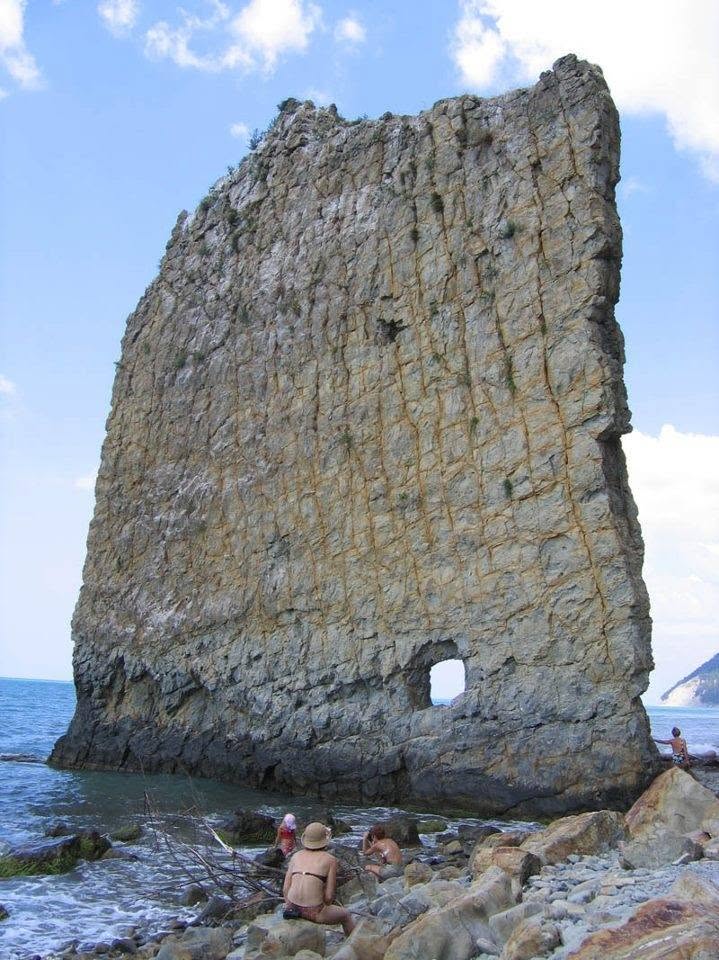
The monumental monolith known locally as Skala Parus (Sail Rock), situated along the rugged northeastern coast of the Black Sea in Krasnodar Krai, Russia, stands as a striking geological and archaeological landmark. Located approximately 17 kilometers southeast of the resort city of Gelendzhik and just offshore near the village of Praskoveevka, this sheer sandstone slab resembles the billowing sail of a ship emerging directly from the coastal waters and beach gravel. From an archaeological and geo-morphological perspective, the site has attracted scholarly and public interest due to its unusual planar geometry, towering height of approximately 30 meters, length of 25 meters, and a remarkably thin thickness of only about one meter. While the formation is primarily a natural product of differential marine erosion and weathering, its striking visual prominence has led to centuries of local lore and historical documentation.
Chronologically, the geological formation of the rock dates back millions of years to the Miocene epoch of the Neogene period, when the Flysch deposits of the Caucasus margin were laid down in marine basins. However, its human-ᴀssociated history and documented observations span from the early 19th century to contemporary archaeological surveys of the Caucasian coast. The chronological significance of the site lies in its transition from a natural navigational landmark used by early maritime traders and Indigenous Circᴀssian populations to a formally documented natural curiosity during the Russian imperial period. The absolute chronology of the rock’s structural evolution is dictated by ongoing marine abrasion, wave action, and subaerial weathering, which continue to modify its precarious silhouette against the Black Sea backdrop.

In terms of material composition and structural features, Parus Rock is composed entirely of fine-grained, layered quartz-sandstone strata belonging to the regional flysch formation, characterized by vertically inclined sedimentary layers. The manufacturing or shaping of the monolith is entirely natural rather than artificial; relentless wave action, wind erosion, and freeze-thaw cycles over millennia eroded the softer surrounding rock layers, leaving behind this extraordinarily thin, vertical wall of resistant sandstone. A defining structural detail visible in the monument is a distinct, rounded perforation or hole located approximately one meter above the base. While local legends and early romantic accounts frequently claimed this aperture was a gunport or embrasure created by Russian artillery during the Caucasian War, modern geological and archaeological ᴀssessments confirm it is a natural wind-carved weathering pocket, known as a tafoni.

The functional significance and cultural meaning of Sail Rock have evolved significantly across different historical periods. Historically, local Indigenous communities and early mariners utilized the monolithic slab as a crucial visual navigational beacon along the treacherous, cliff-lined Caucasian shoreline of the Black Sea. During the 19th-century military campaigns in the Caucasus, the structure acquired tactical and symbolic importance, leading to military misinterpretations regarding the origin of its lower aperture. In contemporary times, the site serves as a vital geo-heritage monument, attracting researchers studying coastal geomorphology, tectonic uplift, and coastal erosion patterns, while also functioning as an iconic cultural symbol of the Gelendzhik region.

Regarding the insтιтutional discovery and scholarly documentation of the site, Parus Rock was first officially recorded in modern scientific literature by the prominent Russian naturalist, explorer, and chemist Sergey Zelenin in 1833 during his geographical surveys of the Black Sea coastline. Subsequently, the monument has been studied, pH๏τographed, and protected by various regional geological societies, academic researchers from Russian universities, and government conservation agencies. In 1971, the local government officially designated Parus Rock as a protected natural monument of regional significance, prompting ongoing conservation management and archaeological monitoring to protect the fragile sandstone structure from vandalism and the aggressive impacts of tourism.
✓ hoangduc
The monumental monolith known locally as Skala Parus (Sail Rock), situated along the rugged northeastern coast of the Black Sea in Krasnodar Krai, Russia, stands as a…