NEARLY 7 INCHES OF RAIN IN HOURS — MAJOR FLASH FLOODING SWEEPS THE NORTHEAST 🌧️🌊🚨

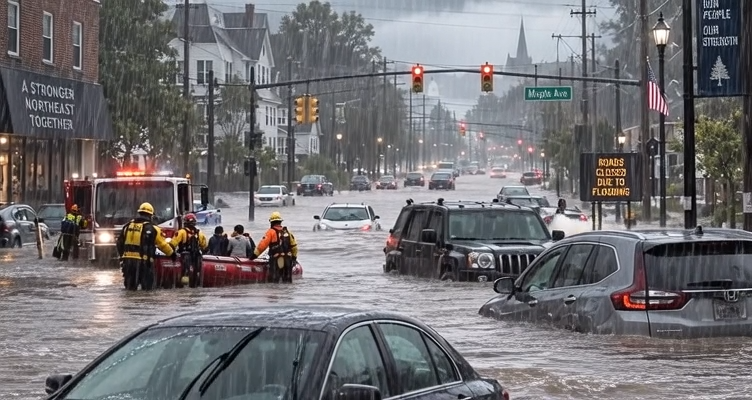
🚨🌧️ NEARLY 7 INCHES OF RAIN TRIGGERS MAJOR FLASH FLOODING ACROSS THE NORTHEAST — WATER RESCUES UNDERWAY AS ROADS DISAPPEAR
A powerful burst of torrential rainfall has unleashed major flash flooding across parts of the Northeast, overwhelming roads, stranding vehicles and forcing emergency crews into action.
Some locations received nearly 7 inches of rain, while rainfall rates reportedly reached an extraordinary 3 to 4 inches per hour.
That kind of rainfall can overwhelm drainage systems in a remarkably short period of time.
And that is exactly what happened across parts of Connecticut and New Jersey.
Streets that were previously open to traffic quickly became flooded and impᴀssable. Vehicles became trapped in rising water, while emergency crews carried out multiple rescues as floodwaters continued spreading through affected communities.
For some residents, the transition from heavy rain to a dangerous flooding emergency happened within hours.
🌊 FLASH FLOODING SPREADS RAPIDLY
Flash flooding is particularly dangerous because it can develop with very little warning.
Unlike slower river flooding, which may provide communities with hours or even days to prepare, flash flooding can transform roads and neighborhoods in a matter of minutes.
When rainfall rates reach several inches per hour, water can accumulate faster than storm drains, streams and other waterways can handle.
Low-lying roads become collection points for runoff.
Creeks and drainage channels can rise rapidly.
And water flowing downhill can converge on streets and neighborhoods with tremendous speed.
Across parts of the Northeast, the intense rainfall created precisely those conditions.
As the rain continued to fall, emergency responders faced an increasingly difficult challenge: reaching people whose vehicles and roads were being overtaken by water.
🚗 MULTIPLE VEHICLE RESCUES IN WESTPORT
In Westport, Connecticut, emergency crews responded to multiple vehicle rescues as floodwater made roads increasingly dangerous.
A vehicle can become a serious hazard once floodwater begins surrounding it.
Drivers may not be able to determine the true depth of the water, and the roadway underneath may have been damaged or covered by debris.
Even when water appears relatively shallow, moving water can push against a vehicle and compromise its stability.
As rainfall continues, conditions can change from pᴀssable to impᴀssable with astonishing speed.
That is why authorities repeatedly warn drivers not to attempt crossing flooded roads.
A road that was safe only minutes earlier may no longer be safe.
And once a vehicle becomes trapped, rescue operations can place both the occupants and first responders at risk.
🇺🇸 AROUND 20 PEOPLE RESCUED IN PATERSON
The flooding emergency was also felt in Paterson, New Jersey, where around 20 people were rescued from rising floodwaters.
The rescue operation highlights just how quickly flood conditions can become life-threatening.
When water begins rising around homes, businesses or vehicles, people may suddenly find themselves with fewer safe options.
Floodwater can block exits, cover roads and isolate neighborhoods.
In such circumstances, emergency crews have to work quickly while continuously evaluating the safety of the surrounding area.
The fact that dozens of people across Connecticut and New Jersey required ᴀssistance demonstrates that this was far more than a routine rainstorm.
It was a rapidly developing flooding emergency.
🌧️ NEARLY 7 INCHES OF RAIN
The rainfall totals help explain why the situation escalated so quickly.
Nearly 7 inches of rain falling over a relatively short period represents an enormous amount of water entering the landscape.
But rainfall totals are only part of the story.
The rate at which rain falls can be just as important.
When rainfall reportedly reaches 3 to 4 inches per hour, drainage systems may be unable to keep pace.
Instead of being absorbed or carried away gradually, water can accumulate across streets and flow rapidly toward lower ground.
That is when flash flooding becomes especially dangerous.
Even areas that do not normally experience significant flooding can encounter problems when rainfall intensity becomes extreme.
🚆 ROADS AND RAIL SERVICE DISRUPTED
The flooding has also disrupted transportation across affected areas.
Road closures and flooded streets can make it difficult for motorists to travel safely, while emergency crews may need to restrict access to particularly dangerous areas.
Rail service has also been affected.
Flooding can interfere with transportation infrastructure, creating delays and disruptions for commuters and travelers even after the heaviest rain begins to weaken.
When multiple transportation systems are affected at once, the consequences can extend well beyond the neighborhoods immediately experiencing the worst flooding.
People may become stranded away from home.
Emergency response routes can become more complicated.
And restoring normal transportation operations can take time after floodwaters recede.
✈️ TWEED NEW HAVEN AIRPORT ALSO IMPACTED
The severe weather also disrupted operations at Tweed New Haven Airport.
Airports are particularly vulnerable to periods of intense rainfall because flooding can affect access roads, surrounding infrastructure and normal airport operations.
For travelers, that can mean delays or disruptions at a time when road conditions are already dangerous.
The combination of flooded roads and disrupted transportation creates another challenge for anyone trying to move through the region.
For residents, avoiding unnecessary travel during the most dangerous part of the storm can reduce the risk of becoming stranded.
⚠️ NEVER DRIVE THROUGH FLOODED ROADS
Perhaps the most important message from this event is one that bears repeating:
Never attempt to drive through flooded roads.
It can be impossible to accurately judge how deep the water is from inside a vehicle.
Floodwater may conceal potholes, damaged pavement, debris or sections of roadway that have been washed away.
And moving water can be much stronger than it appears.
A vehicle can lose traction or become disabled, leaving occupants trapped in rapidly rising water.
If you encounter a flooded roadway, the safest decision is to turn around and find another route.
Do not ᴀssume that a familiar road is safe simply because you have driven it many times before.
Flooding can completely change road conditions in a matter of minutes.
📱 STAY ALERT AS CONDITIONS CHANGE
Residents across Connecticut, New Jersey and other parts of the Northeast should continue monitoring official weather and emergency alerts when severe rainfall is occurring.
Conditions can evolve quickly.
A heavy downpour can cause water levels to rise rapidly, while flooding may continue even after the rain temporarily decreases.
Water can also continue moving downstream from areas that received the heaviest rainfall.
That means people should not automatically ᴀssume that the danger is over simply because the rain has stopped at their location.
Keep phones charged and make sure emergency notifications are enabled where available.
If authorities issue evacuation instructions or road closures, follow them immediately.
🏠 CHECK ON VULNERABLE NEIGHBORS
During major flooding events, some people may need additional ᴀssistance.
Older residents, people with mobility challenges and families in low-lying areas may have difficulty responding quickly when water begins rising.
If it is safe to do so, checking on vulnerable neighbors can make a meaningful difference.
But personal safety should always come first.
Do not enter dangerous floodwater or attempt a rescue without the proper equipment and training.
Emergency responders are equipped to handle situations that can be extremely hazardous for untrained individuals.
🌊 THE FLOOD THREAT CAN CONTINUE AFTER THE RAIN
One of the biggest misconceptions about flash flooding is that the danger ends as soon as the rainfall stops.
It doesn’t always work that way.
Water from higher ground continues flowing downhill.
Creeks and rivers can keep rising.
Drainage systems may remain overwhelmed.
And roads that were flooded earlier can remain dangerous because of debris, structural damage or standing water.
For that reason, residents should continue exercising caution even after the skies begin to clear.
The recovery process can take time.
🚨 A DANGEROUS REMINDER FOR THE ENTIRE NORTHEAST
Nearly 7 inches of rain.
Rainfall rates reportedly reaching 3 to 4 inches per hour.
Multiple vehicle rescues in Westport.
Around 20 people rescued from rising floodwaters in Paterson.
Roads and rail service disrupted.
And operations at Tweed New Haven Airport affected.
Together, these details paint a picture of a rapidly developing flash-flood emergency across parts of the Northeast.
For those experiencing the flooding firsthand, this is not simply a dramatic weather headline.
It is a situation that can become dangerous with almost no warning.
🌧️🚨 IF YOU ARE IN CONNECTICUT, NEW JERSEY OR ANYWHERE ACROSS THE NORTHEAST, STAY ALERT.
Avoid flooded roads.
Do not drive through standing or moving water.
Monitor official warnings.
And if conditions begin deteriorating around you, move to a safer location before floodwater cuts off your route.
👇 Anyone across Connecticut, New Jersey or the Northeast seeing flooding where you are? Stay safe and share what conditions look like in your area.
✓ Team
🚨🌧️ NEARLY 7 INCHES OF RAIN TRIGGERS MAJOR FLASH FLOODING ACROSS THE NORTHEAST — WATER RESCUES UNDERWAY AS ROADS DISAPPEAR A powerful burst of torrential rainfall has…