The case surrounding the death of Nolan Wells continues to grow more complicated after an independent forensic expert highlighted a detail that could prove particularly important: a portion of the structures from the front of Nolan’s neck was retained following the initial autopsy and was not provided to the doctor who later performed the independent examination.
This does not prove that Nolan was strangled.
But it turns what had largely circulated as online speculation into a legitimate forensic question—one that can only be properly addressed through physical evidence.
Dr. Judy Melinek, a board-certified forensic pathologist who is not directly involved in the investigation, explained that when a body is recovered from water, drowning is often considered a “diagnosis of exclusion.”
In other words, before determining that someone died from drowning, forensic pathologists must first rule out other possible causes, including trauma, strangulation, gunsH๏τ injuries, or medical conditions.
That distinction is precisely what makes the Nolan Wells case so sensitive.
If someone died from strangulation and was subsequently placed in the water, the cause of death would remain strangulation—not drowning.
The Critical Detail Is in the Neck
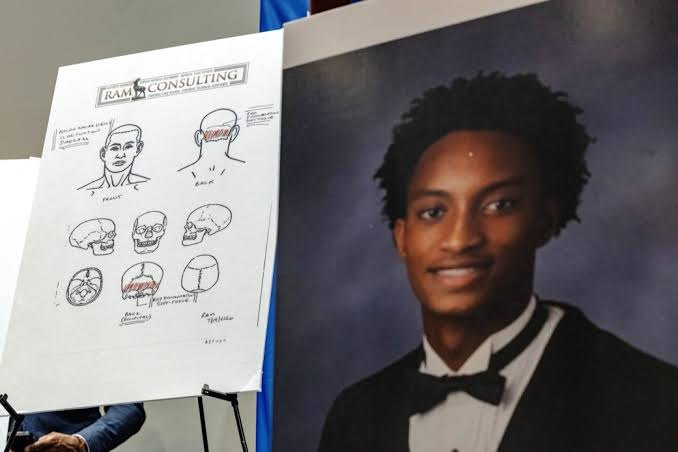
According to the information that has been made public, when Dr. Roger Mitchell performed the second autopsy, he did not have the opportunity to examine an important portion of the front of Nolan’s neck.
This area contains the airway, major blood vessels, and other structures forensic pathologists commonly examine when there is a possibility that pressure was applied to the neck.
Melinek explained that if manual strangulation had occurred, potentially significant injuries could be found in precisely this region.
Experts may examine the hyoid bone, the muscles running along the front of the neck, and signs of hemorrhaging within the soft tissues.
A fractured hyoid bone or bleeding within the neck muscles could represent significant findings, although no single finding automatically proves strangulation.
The notable point is that this tissue remained in the possession of the office responsible for the initial examination.
But this is also where caution becomes essential.
According to Melinek, forensic pathologists retaining tissue or organs in a sensitive or high-profile case is normal forensic practice.
Material may be preserved for additional testing, retained as evidence, or simply kept out of an abundance of caution.
The fact that tissue was retained is not, by itself, evidence of concealment.
The unresolved issue is that the public still does not know why this particular neck tissue was retained.
Was it kept simply as part of routine procedure?
Or did the original examiner observe something requiring further examination?
Until the initial autopsy report becomes available, that remains unclear.
Discoloration Behind the Head: Injury or an Autopsy Artifact?
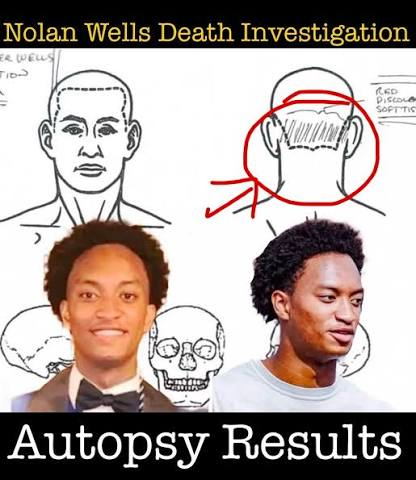
Another detail attracting attention from the second examination involves a large area of reddish discoloration within the deep soft tissues at the back of Nolan’s head.
At first glance, that might sound like an alarming red flag.
But Melinek offered another, considerably less dramatic possibility.
She explained that the back of the head is a location where a support block may commonly be placed during an autopsy.
Pressure from the head resting against such a block during the initial examination could potentially produce discoloration in the soft tissues and create an appearance that might resemble an injury.
Notably, the report discussed in connection with the case indicated that there was no laceration of the overlying skin and no corresponding skull fracture.
Determining whether the discoloration represents genuine hemorrhaging caused by trauma, postmortem changes, or something ᴀssociated with the earlier examination requires microscopic analysis of the tissue.
In other words, it is a clue—but not yet a conclusion.
Toxicology May Not Be the “Golden Key”
Another major piece of evidence being closely watched is toxicology.
Melinek cautioned, however, that alcohol readings in a decomposing body must be interpreted extremely carefully.
Bacterial activity after death can produce ethanol, potentially increasing measured alcohol levels beyond what a person actually consumed while alive.
That complication becomes particularly relevant when a body has spent time in water and undergone decomposition.
For that reason, a single toxicology number cannot independently solve a case like this.
When asked whether Nolan’s case could ultimately come down to toxicology results, Melinek expressed doubt.
Instead, she emphasized that the decisive factor will likely be the broader investigation into the scene and circumstances: how Nolan entered the water, whether he was alone during his final moments, and whether anyone else was present.
The Real Answer May Lie in Nolan’s Final Minutes
That may ultimately be the most important part of this entire case.
Not one laboratory number.
Not one area of discoloration.
And not even the retained neck tissue by itself.
The key could instead be the sequence of events during Nolan’s final minutes before he entered the water.
Attorney Ben Crump’s team is reportedly working to obtain access to the retained tissue, as well as pH๏τographs and observations from the original state examination.
Access to that material could allow the independent examiner to compare his findings with what was observed when Nolan’s body was in a less advanced state of decomposition.
At this stage, however, the case cannot be closed with a simple conclusion.
The independent examination did not conclude that Nolan’s death was an accident.
But it did not conclude that his death was a homicide either.
The finding was described as “undetermined.”
And it is that word—undetermined—that continues to hang over the Nolan Wells case.
Because if the answer lies within neck tissue that has not yet been independently examined, outstanding forensic testing, or final moments that have not yet been completely reconstructed, then one of the most important pieces of this case may still remain outside public view.
Until the original autopsy report, the retained tissue, and the complete forensic evidence are fully evaluated, conclusions involving strangulation, drowning, or homicide must remain unproven.
But one thing is becoming increasingly clear:
The Nolan Wells case is far from over.