The Architectural Wonder of Sacsayhuamán: The Pinnacle of Inca Stonework Engineering
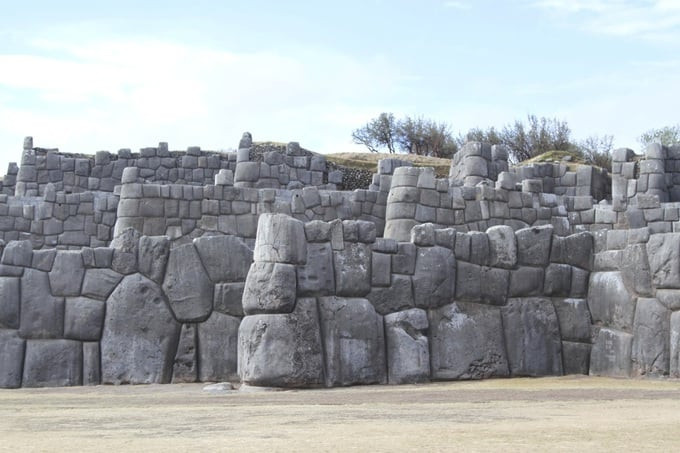
The magnificent architectural complex captured in the image is the colossal stone rampart of the Sacsayhuamán fortress, one of the most impressive military and ceremonial structures of the Inca civilization. Situated on a high hillside overlooking the Cusco Valley—the empire’s capital—this site held a position of paramount strategic importance for both defense and spiritual significance. From an architectural-archaeological perspective, these mᴀssive, zigzagging tiered walls served not merely as fortifications but also symbolized the teeth of a sacred puma, a guardian spirit in Inca cosmology. The ingenious integration of the surrounding landscape with the immense scale of the stone blocks makes the site a vivid testament to the supreme power and might of the Inca state at that time.
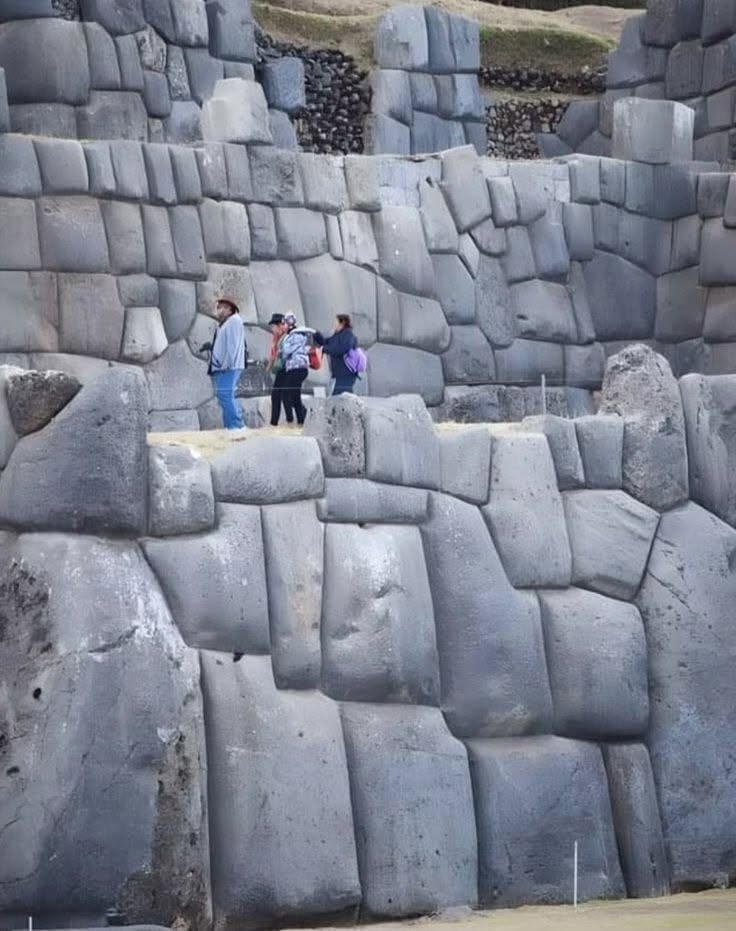
The primary materials used to construct these walls were limestone or extremely hard grey andesite, quarried from sites located several kilometers away. From an engineering standpoint, the most astonishing aspect is the craftsmanship: stone blocks weighing tens or even hundreds of tons were carved with absolute precision into polygonal shapes that interlocked тιԍнтly—like a complex three-dimensional puzzle—without the use of any binding mortar. Inca laborers and master masons employed hard stone tools, bronze hammers, and techniques involving sand and water abrasion to refine each stone’s edges, ensuring a perfect fit with adjacent blocks.

This precision-fitting technique allowed the stones to shift slightly and effectively absorb seismic forces during earthquakes—a frequent geological occurrence in the Andes region. In terms of significance and function, the multi-layered defensive structure at Sacsayhuamán served to protect the seat of power in the capital, Cusco, while also acting as a sacred space for large-scale state religious ceremonies. The zigzagging walls created strategic angles for crossfire, enabling Inka forces to easily control the area, encircle adversaries, and repel external attacks. Furthermore, the mobilization of tens of thousands of laborers from across the empire to transport and ᴀssemble these colossal stone blocks held profound social significance; it reflected the highly efficient *mita* (public labor) system and the strong cohesion among communities under the rule of the Sapa Inka emperor.
Thus, the structure stands as both an impregnable military fortress and a symbol of submission to the cosmic order established by the Inka people. The study, preservation, and excavation of the Sacsayhuamán site complex represent the collaborative efforts of generations of archaeologists, historians, and Peruvian national heritage agencies spanning the early 20th century to the present day. Pioneering archaeologists and international research teams have conducted detailed mapping, cleared layers of accumulated sediment, analyzed foundation structures, and investigated deep-seated cultural strata to elucidate labor organization methods and the precise chronology of each construction phase.

These excavation efforts have revealed the structure’s original beauty—long obscured by vegetation and the ravages of the Spanish conquest—thereby providing invaluable data to the global field of architectural archaeology. Today, Sacsayhuamán stands firm as one of the greatest archaeological legacies of pre-Columbian America, drawing millions of researchers and tourists annually. Recognized by UNESCO as a World Heritage Site, the complex remains a focal point for scholarly debate regarding the extraordinary mechanical, mathematical, and engineering capabilities of indigenous South Americans. The careful preservation and study of this site not only safeguard the physical integrity of its millennia-old stone walls but also help sustain the historical memory and profound cultural pride of the Andean indigenous people regarding their ancestral heritage.
✓ Ryan Mitchell
The magnificent architectural complex captured in the image is the colossal stone rampart of the Sacsayhuamán fortress, one of the most impressive military and ceremonial structures of…