The Areni-1 Shoe: A 5,500-Year-Old Masterpiece of Chalcolithic Craftsmanship
The organic artifact presented in this archaeological record is the Areni-1 shoe, recognized as the oldest piece of leather footwear ever discovered. It was unearthed in 2008 within the Areni-1 cave complex (also known as the Birds’ Cave) located in the Vayots Dzor province of Armenia. Through rigorous AMS (Accelerator Mᴀss Spectrometry) radiocarbon dating performed at laboratories in Oxford and California, the shoe was determined to date back to approximately 3500 BCE, placing it firmly in the Chalcolithic (Copper Age). This era was a transformative period for the Southern Caucasus, marked by early advancements in metallurgy and viticulture. The shoe’s survival is attributed to the cave’s stable, cool, and dry microclimate, as well as a thick layer of sheep dung that acted as a natural preservative, sealing the leather away from oxygen and moisture for over five millennia.

From a material perspective, the Areni-1 shoe is composed primarily of a single piece of bovine hide, likely from a cow. The choice of cowhide speaks to the importance of domesticated cattle in the Chalcolithic economy of the region. Analysis suggests the leather was treated with a vegetable oil or fat to maintain its suppleness, a primitive yet effective tanning process. A crucial secondary material found inside the shoe is dried grᴀss (Gramineae). This grᴀss was not merely incidental; it was deliberately stuffed into the shoe. Archaeologists debate whether the grᴀss served as insulation to protect the foot from the cold Armenian winters or as a shaping medium to maintain the shoe’s structure while it was not being worn. The presence of these organic fibers provides a rare glimpse into the complex relationship between early humans and their botanical environment.

The fabrication of the Areni-1 shoe demonstrates a sophisticated “chaine opératoire” of prehistoric tailoring. It is a “pampootie” style shoe, made from a single piece of leather that wrapped around the foot. The craftsman used a sharp stone tool to create a series of small, precise slits along the edges of the hide. Through these slits, a leather thong or cord was threaded to pull the leather together at the front and back, as highlighted in the microscopic detail views of the record. The shoe was custom-fit to the wearer’s right foot (measuring about a modern European size 37). The construction lacks a separate sole, meaning the wearer would have felt the terrain directly, yet the thick hide provided essential protection against the sharp limestone and thorns characteristic of the Vayots Dzor landscape.

The primary function of the Areni-1 shoe was protection and mobility. In the rugged terrain of the Southern Caucasus, high-quality footwear was a technological necessity that allowed for longer-distance foraging, hunting, and the tending of livestock. Beyond simple utility, the shoe represents a significant investment of time and resources, suggesting a level of socio-economic specialization. The fact that it was found in a cave that also housed the world’s oldest known winery suggests that the people of Areni-1 lived in a complex, sedentary society. The shoe might have been a personal possession of a high-status individual or a specialized laborer. Its discovery challenges previous ᴀssumptions about the timeline of leather-working development, proving that humans had mastered the ergonomic shaping of footwear long before the rise of the Great Pyramids.
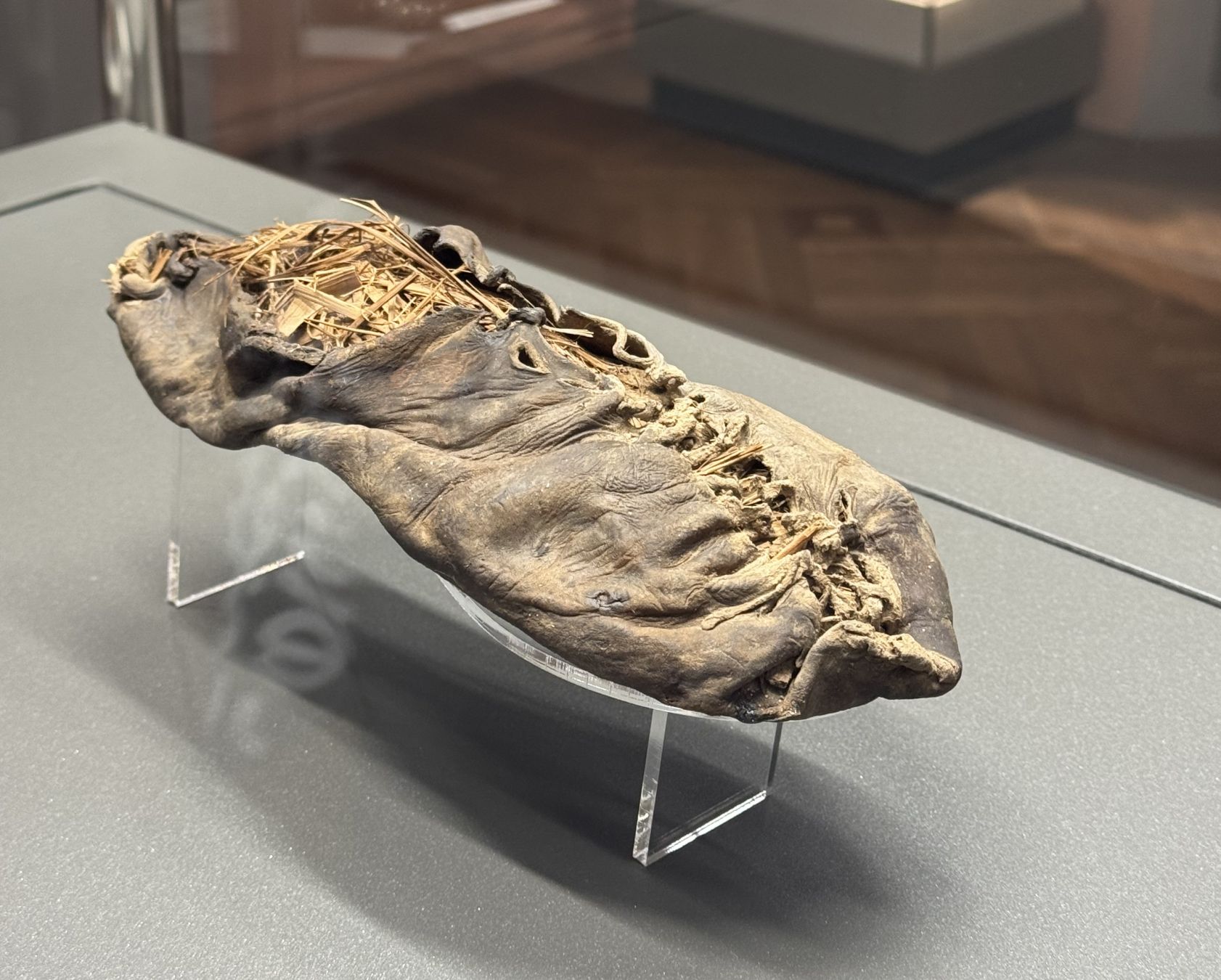
The Areni-1 shoe was discovered by an international team of researchers during a systematic excavation of the cave. The project was a collaboration between the Insтιтute of Archaeology and Ethnography of the National Academy of Sciences of Armenia, University College Cork (Ireland), and the University of California, Los Angeles (UCLA). The lead author of the discovery was Dr. Ron Pinhasi. As seen in the documentation, the shoe was recovered with extreme care to prevent the brittle leather from crumbling upon exposure to the air. Today, the artifact is a centerpiece of the History Museum of Armenia in Yerevan. Modern conservation involves keeping the shoe in a nitrogen-filled case with strictly controlled humidity and temperature to ensure that this 5,500-year-old witness to human ingenuity remains preserved for future DNA and isotopic analysis.
✓ Team
The organic artifact presented in this archaeological record is the Areni-1 shoe, recognized as the oldest piece of leather footwear ever discovered. It was unearthed in 2008…