The Colossal Pantheon of Mount Nemrut: An Archaeological Marvel
Posted by hoangduc - August 17, 2026
Rising 2,150 meters above the rugged landscape of southeastern Turkey, Mount Nemrut stands as a silent testament to the hubris and ambition of the Hellenistic era. This monumental site was commissioned in the 1st century BCE, specifically around 62 BCE, by King Antiochus I Theos of Commagene. The complex was designed as a hierothesion—a sacred tomb-sanctuary and dwelling for the gods—intended to immortalize the king’s legacy by blending his ancestral Persian and Greek heritage into a singular, divine idenтιтy. The site remained hidden from the modern world until 1881, when Karl Sester, a German engineer conducting a survey of transport routes for the Ottoman Empire, stumbled upon the ruins. Following this discovery, formal archaeological interest intensified, leading to landmark investigations by figures such as Otto Puchstein, Osman Hamdi Bey, and later, the American archaeologist Theresa Goell, whose mid-20th-century campaigns provided much of our current structural understanding.
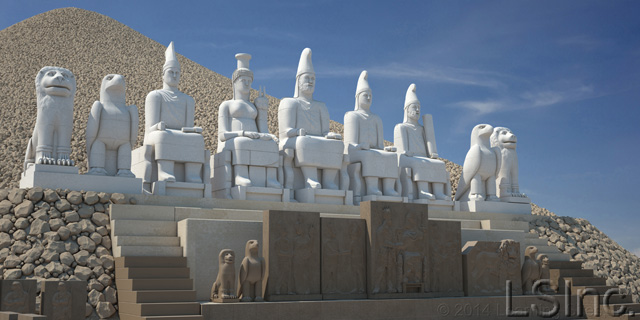
The physical construction of the site is an engineering masterpiece of the ancient world. The statues were carved from local limestone quarried directly from the mountain and transported to its peak, where they reached staggering heights of eight to ten meters. These colossal figures—comprising the King himself, a personification of the land of Commagene, and a fusion of Greco-Iranian deities like Zeus-Oromasdes, Heracles-Artagnes-Ares, and Apollo-Mithras-Helios-Hermes—were crafted with a meticulous combination of Greek artistic facial features and Persian-style clothing and hairstyles. Each statue was built from multiple blocks, joined without mortar, and positioned on thrones, while the surrounding terraces were adorned with sandstone stelae depicting the king’s royal lineage. Over centuries, the heads of these statues were separated from their bodies—likely due to seismic activity or intentional iconoclasm—and now rest on the ground, offering an intimate, eye-level glimpse into the refined sculpting techniques of the period.

Beyond their aesthetic brilliance, the statues serve as a profound expression of Antiochus I’s religious and political syncretism. By situating his own image among the gods, the king sought to solidify his position as a divine intermediary, bridging the gap between mortal rule and celestial authority. The site was far from purely decorative; the layout was deeply rooted in astronomical precision. For instance, the east and west terraces were oriented toward the sunrise and sunset on significant dates, such as the anniversary of the king’s accession and his birthday. Furthermore, a famous “lion horoscope” relief discovered on the site displays a specific arrangement of stars and planets, believed by many scholars to map the sky on July 7, 62 BCE, perhaps marking the very inception of this monumental cult center.
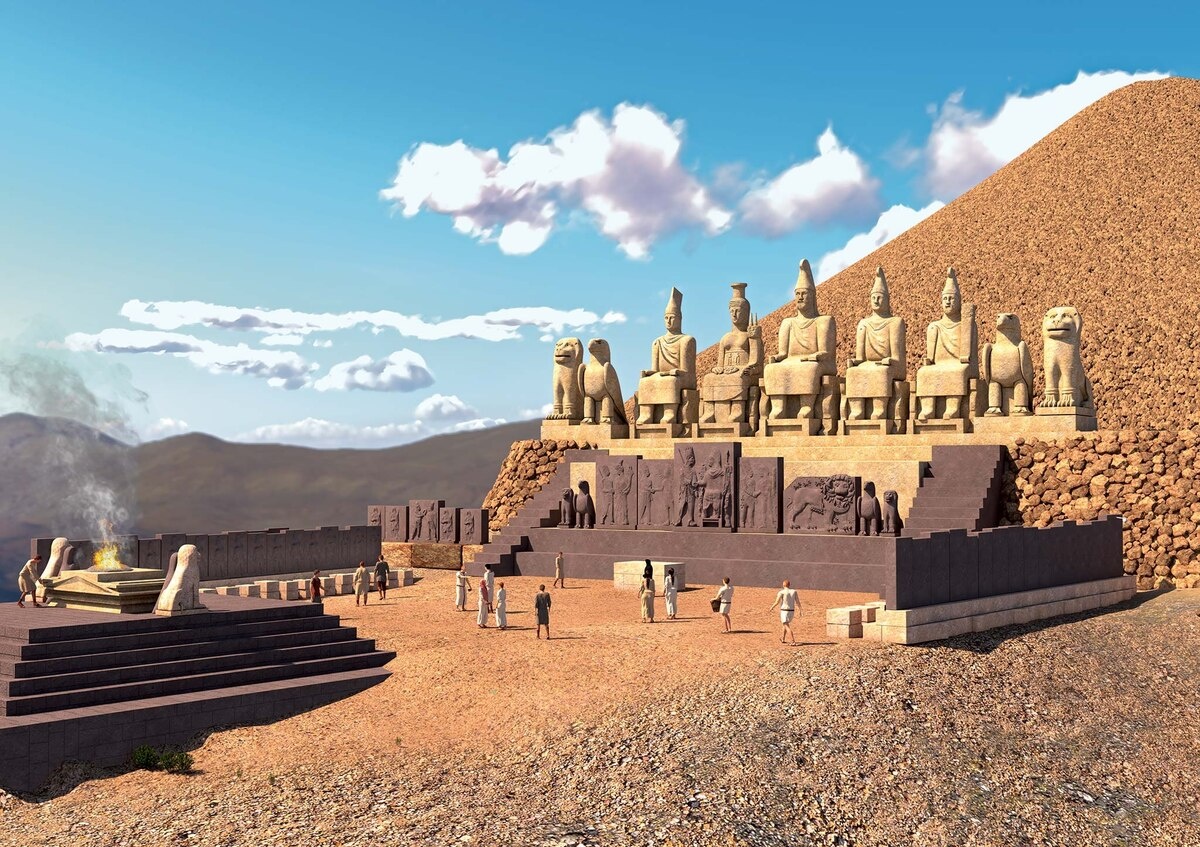
The tumulus itself, a conical mound of loose rock 50 meters high and 152 meters in diameter, remains one of archaeology’s most tantalizing “locked rooms”. While it is widely ᴀssumed to be the final resting place of Antiochus I, the tomb chamber has yet to be physically accessed by modern researchers. The design of the mound—constructed of small, loose stones—was likely a deliberate defensive strategy to deter grave robbers, as any attempt to tunnel into the pile would cause the surrounding material to shift and fill the gap, effectively burying the intruders. Even with the application of ground-penetrating radar in 2012, which suggested a possible subterranean chamber near the peak, the secret of the king’s tomb remains securely guarded by the mountain’s geological bulk.
Today, the site is recognized as a UNESCO World Heritage treasure, representing a unique convergence of East and West. The conservation of these monuments is an ongoing struggle against the harsh Anatolian climate, where severe freezing-thawing cycles and wind erosion continue to deteriorate the limestone surfaces. Despite this decay, the silent sentinels of Mount Nemrut continue to serve their intended purpose: they defy oblivion. As visitors gaze upon the fragmented, yet still regal faces of the gods and their king, they are participating in the same ritual of memory that Antiochus I envisioned two millennia ago—a testament to the enduring power of stone to preserve the fragile, grandiose aspirations of human civilization.
✓ hoangduc
Rising 2,150 meters above the rugged landscape of southeastern Turkey, Mount Nemrut stands as a silent testament to the hubris and ambition of the Hellenistic era. This…