The Colossi of Memnon: Sentinels of the Theban Necropolis
The mᴀssive twin statues featured in the image are the Colossi of Memnon, located on the West Bank of the Nile near the modern city of Luxor, Egypt. These monuments date to the 18th Dynasty of the New Kingdom (c. 1350 BCE), specifically during the long and prosperous reign of Pharaoh AmenH๏τep III. This era represents a “Golden Age” of Egyptian history, a period of unprecedented imperial wealth and artistic refinement. The Colossi were originally built to stand as guardians at the entrance of AmenH๏τep III’s Mortuary Temple, which was the largest and most opulent temple complex in the ancient world, even dwarfing the famous Temple of Karnak. Today, the statues are all that remain of this vanished complex, serving as chronological anchors for one of Egypt’s most ambitious building programs.
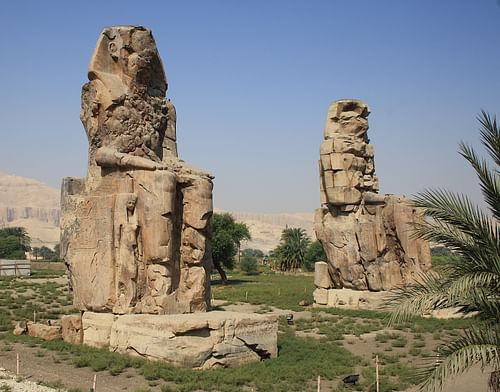
While the Colossi have been a visible part of the Egyptian landscape for over three millennia, their modern archaeological investigation has been a continuous process of rediscovery. Ancient Greeks and Romans visited the site as “tourists,” famously hearing the “song” of the northern statue—a phenomenon caused by wind pᴀssing through earthquake-damaged stone. Scientific documentation began in earnest with the Napoleon Expedition (1798) and was followed by the work of Richard Lepsius in the 19th century. In the late 20th and early 21st centuries, the Colossi of Memnon and AmenH๏τep III Temple Conservation Project, led by archaeologist Dr. Hourig Sourouzian, has revolutionized our understanding of the site. This project, supported by the Egyptian Ministry of Antiquities, has uncovered hundreds of additional fragments, statues, and stelae buried in the surrounding agricultural land, effectively “resurrecting” the layout of the lost temple.

The Colossi are carved from quartzite sandstone, a material known for its extreme hardness and durability. This specific stone was not found locally; it was quarried at Gebel el-Ahmar (the Red Mountain), near modern-day Cairo, and transported over 675 kilometers (420 miles) upstream to Thebes. Each statue is a monolith, originally standing about 18 meters (60 feet) tall and weighing an estimated 720 tons each. The craftsmanship involved in carving such a hard material with bronze and stone tools is staggering. The sides of the thrones, visible in the foreground, feature a high-relief carving known as the Sema-Tawy, depicting the Nile gods Hapi binding together the papyrus and lotus plants. This detail was not merely decorative but was a technical masterpiece of symmetry, symbolizing the Pharaoh’s role in uniting Upper and Lower Egypt into a single, cohesive state.

In terms of utility, the Colossi served as ceremonial guardians or “colossal ushabtis” for the Pharaoh’s soul. Their primary function was to protect the boundary between the world of the living and the sacred ground of the mortuary temple. However, their meaning was also deeply solar. Facing the rising sun in the east, the statues were intended to catch the first light of day, symbolizing the Pharaoh’s daily rebirth and his identification with the sun god Ra. The smaller figures carved into the thrones represent AmenH๏τep III’s mother, Mutemwia, and his Great Royal Wife, Tiye, providing a familial context that anchored the Pharaoh’s divine status in human lineage. The statues acted as a permanent, immovable broadcast of imperial power, meant to outlast the Pharaoh’s mortal life and ensure his eternal presence in the Theban landscape.
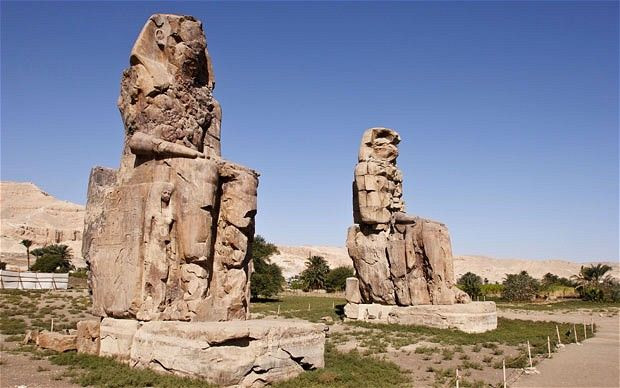
The Colossi of Memnon remain a critical laboratory for the study of ancient Egyptian logistics and seismic history. For archaeologists, the repair work visible on the northern statue—conducted by the Roman Emperor Septimius Severus in 199 CE—provides a rare “lithic record” of ancient restoration efforts. Furthermore, the statues have provided vital data for geomorphological studies of the Nile floodplain; the fact that the temple they guarded was destroyed by floods and earthquakes highlights the environmental challenges faced by New Kingdom architects. Today, as a key part of the Ancient Thebes UNESCO World Heritage site, the Colossi continue to be monitored for environmental erosion and groundwater damage. They stand as defiant, weathered witnesses to a civilization that viewed stone as the ultimate medium for immortality, ensuring that the name of AmenH๏τep III would never be forgotten.
✓ Team
The mᴀssive twin statues featured in the image are the Colossi of Memnon, located on the West Bank of the Nile near the modern city of Luxor,…