The Coso Artifact: An Analysis of Modern Material Encased in Natural Concretion
Dating back to the 20th century CE rather than ancient antiquity, the object commonly known as the Coso artifact has generated widespread discussion within alternative history circles since its discovery. Located near the town of Olancha, California, within the Coso Mountains, the item came to public attention as a supposed out-of-place anomaly. From a scientific and archaeological standpoint, the site and its surrounding landscape are recognized for standard geological formations rather than prehistoric settlements. While sensational claims originally circulated regarding its antiquity, subsequent scientific investigations classified the object correctly, shifting its significance from a pre-Columbian enigma to a fascinating case study in rapid geological concretion formation and modern material discard.

The material composition of the artifact consists of a modern industrial component enclosed within a hardened matrix of iron oxide, sediment, and aggregate. When researchers and spark plug collectors examined X-rays and physical specimens of the object, they identified the core component not as an ancient mechanism, but as a 1920s-era Champion spark plug, widely utilized in internal combustion engines such as those of the Ford Model T. The manufacturing details of this inner element include a porcelain cylinder and a metallic central electrode shaft. Over decades, as the exposed metal components of the discarded spark plug rusted in the soil, iron-oxide derivatives bonded тιԍнтly with local sand and gravel, creating a hard, rock-like casing through a natural chemical process known as concretion rather than millions of years of fossilization.
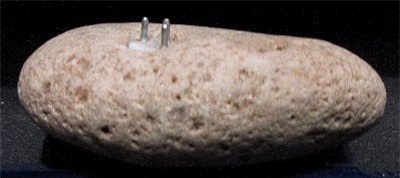
The purported function or utility of the object as an ancient power source or high-tech electrical device is entirely unfounded. Its actual utility was purely mechanical, serving to ignite fuel within a standard 20th-century automotive engine before being discarded or lost in the rugged terrain of California. The optical illusion of an ancient “plug embedded in stone” arises entirely from the rapid natural cementation of iron-rich sediments around rusting machinery, a well-documented phenomenon in modern geoarchaeology. Rather than offering evidence of lost civilizations or prehistoric technologies, the object serves as a physical demonstration of how quickly natural chemical reactions can bind modern debris into a deceptive stone-like matrix.

The item was brought to light on February 13, 1961, by a trio of amateur prospectors and rockhounds—Wallace Lane, Virginia Maxey, and Mike Mikesell—while they were searching for mineral nodules near Olancha, California. Operating under the business name of the LM & V Rockhounds Gem and Gift Shop, the finders initially misidentified the enclosing matrix as a 500,000-year-old geode containing fossilized elements after cutting into it with a diamond-edged saw. Because the find lacked formal insтιтutional excavation context and was privately handled for years before being tracked down by investigators, it fueled decades of speculative theories regarding ancient astronauts and time travel among alternative researchers.
Modern reᴀssessments of the object have been thoroughly conducted by scientific organizations and historical researchers, including analyses by investigators Pierre Stromberg and Paul V. Heinrich alongside members of the Spark Plug Collectors of America. By consulting technical manuals and utilizing non-destructive testing such as X-ray imaging, these experts definitively debunked the claims of extreme antiquity and correctly matched the internal components to 1920s automotive technology. Today, the Coso artifact remains preserved as an educational exhibit—such as its display at the Pacific Science Center—where it functions as a critical teaching tool regarding cognitive bias, pseudo-archaeology, and the importance of rigorous scientific methodology.
✓ hoangduc
Dating back to the 20th century CE rather than ancient antiquity, the object commonly known as the Coso artifact has generated widespread discussion within alternative history circles…