The Enigmatic Sailing Stones of Racetrack Playa: A Geological and Archaeological Inquiry into Nature’s Kinetic Artifacts
The enigmatic phenomenon known as the “Sailing Stones” represents one of the most compelling natural kinetic wonders on Earth, bridging the gap between deep geological time and modern scientific inquiry. Situated within a prehistoric landscape shaped roughly sixteen million years ago, these geological formations have captured human imagination for centuries, with initial documentation by local miners and prospectors dating back to the early 1900s. Although these stones do not represent anthropogenic artifacts fashioned by human hands, researchers study them through a rigorous geo-archaeological lens to decode the chronological timeline of environmental shifts. The active tracks left behind by these monolithic blocks chronicle centuries of intermittent climatic variations, offering a durable historical record inscribed directly upon the floor of an ancient, arid basin.

The primary site of discovery is the remote Racetrack Playa, a remarkably flat, dry lakebed located in the northwestern section of Death Valley National Park, California. Spanning approximately five kilometers long and two kilometers wide, this desolate basin is virtually devoid of vegetation and is characterized by a sun-baked surface of fine-grained, hexagonally cracked clay. The geographical isolation and extreme climate of the location create an environment where natural forces operate undisturbed by heavy human intervention. The surrounding mountain ranges, rising up to 1,700 meters high, serve as the geographical source from which these mᴀssive stones originally detached, tumbling down through continuous processes of natural erosion onto the flat mud surface below.
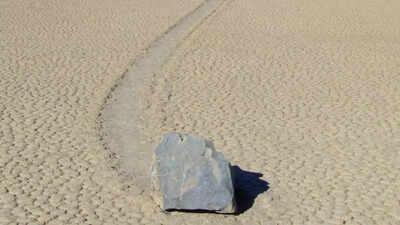
Examining the material composition reveals that these traveling specimens are composed primarily of dolomite and syenite, matching the exact mineralogical profile of the steep slopes that border the playa. Ranging in scale from small pebbles to colossal boulders weighing up to 320 kilograms (700 pounds), these lithic mᴀsses display diverse physical morphologies, including rough or smooth bases that directly dictate their traveling mechanics. The “craftsmanship” behind their movement is entirely natural yet remarkably precise: a rare orchestration of elements where winter rains form a shallow, temporary pond, subsequent freezing temperatures generate delicate “windowpane” ice sheets measuring only millimeters thick, and gentle daytime winds propel these ice panels to act as microscopic bulldozers.

From a scientific and functional standpoint, the movement of these stones serves as a masterclass in geomorphological dynamics and environmental physics, resolving a decades-long mystery that once spawned fringe theories of magnetism and paranormal activity. As the thin sheets of floating ice fracture and accumulate behind the heavy rocks under light breezes, they exert just enough friction and buoyant force to skim the boulders across the lubricated, muddy lakebed at imperceptible speeds of a few meters per minute. This slow, deliberate sliding leaves behind long, linear, and sometimes synchronized tracks that can persist across the desert floor for over a decade, providing researchers with visible, measurable vectors of ancient meteorological power.
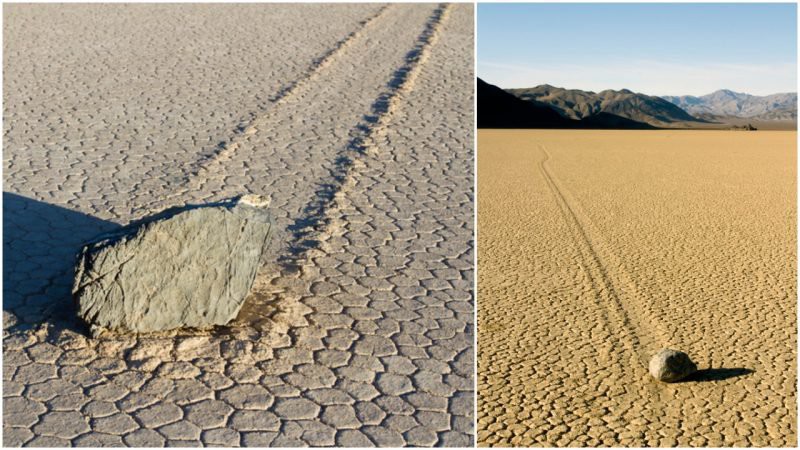
The definitive documentation and unravelling of this geological mystery were achieved through the persistent efforts of modern scientific expeditions, most notably a research team led by paleobiologist Richard Norris of the Scripps Insтιтution of Oceanography and engineer James Norris. Building upon decades of foundational mapping and monitoring programs initiated earlier by geologists such as Jim McAllister, Allen Agnew, and Bob Sharp—who famously labeled and tracked individual stones like “Karen” and “Mary Ann” over multi-year periods—the contemporary team utilized advanced high-resolution weather stations and GPS-tagged stones. Their breakthrough field observations in the winter of 2013-2014 successfully captured the phenomenon in real-time, officially transforming an enduring desert myth into a fully understood scientific reality.
✓ Ryan Mitchell
The enigmatic phenomenon known as the “Sailing Stones” represents one of the most compelling natural kinetic wonders on Earth, bridging the gap between deep geological time and…