The Enigmatic Stone Chariot: A Glimpse into Ancient Play
The artifact depicted in the image is a remarkable archaeological find often discussed in the context of early human craftsmanship and the conceptualization of transportation. Resembling a primitive wheeled vehicle, this object is frequently attributed to the Late Chalcolithic period, dating back approximately 5,000 to 7,500 years. Discovered in regions like Mardin, Turkey, it serves as a captivating testament to the ingenuity of prehistoric societies. While some debate whether such objects were functional models or purely symbolic, they are widely recognized by researchers as among the earliest known examples of toy-like structures featuring wheel-like appendages, offering a rare window into the childhood and leisure activities of ancient cultures.
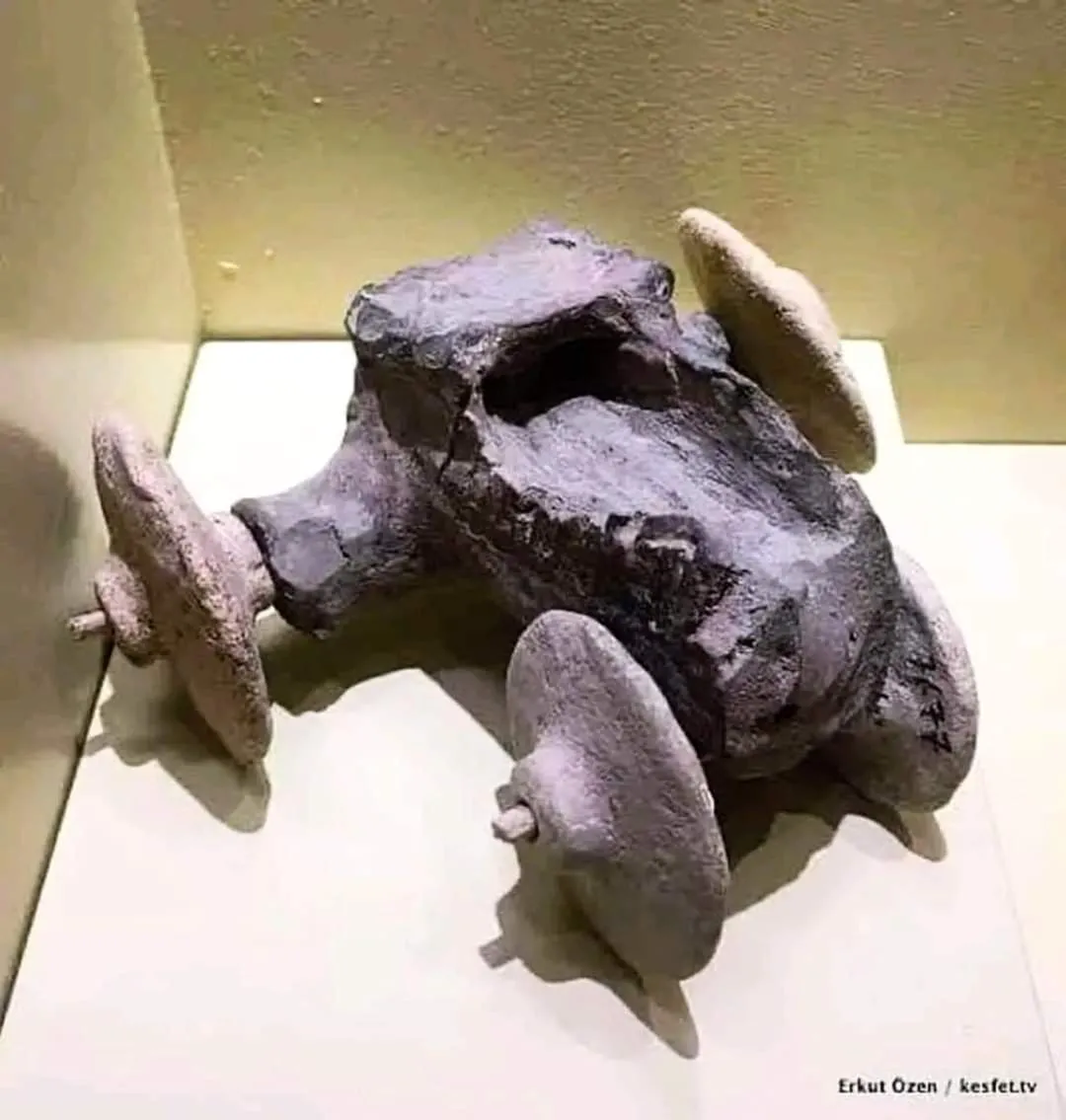
Constructed primarily from stone, the artifact showcases the sophisticated lithic skills of its creators. The “body” of the vehicle is carved from a solid block of stone, featuring a hollowed-out central section that suggests a carriage or seating area. The wheels, separate circular discs of stone, are attached via crude, rudimentary axles—or in some interpretations, are simply positioned alongside the body, highlighting an early experimentation with the concept of rotational motion. The texture of the stone, weathered by millennia, reflects the manual techniques employed by Neolithic or Chalcolithic artisans, who utilized primitive stone tools to chip, grind, and shape the material into this durable, miniature form.

Archaeologists and historians view this object not merely as a plaything, but as a significant cultural signifier. During this transitional era, the invention of the wheel was beginning to revolutionize human mobility, agriculture, and warfare. A toy modeled after a cart suggests that wheeled transport was already a well-integrated, or at least highly visible, part of daily life. By recreating the technology of the adult world in miniature, children of the time may have been participating in a form of early socialization and technical literacy, mirroring the tasks their parents performed, such as transporting goods or crops across the rugged landscapes of the Near East.
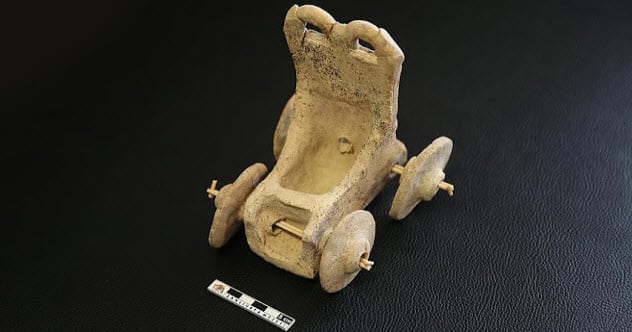
The discovery of such items is usually the result of careful stratigraphic excavation by international archaeological teams, often operating under the supervision of local museums and heritage authorities. The find in Mardin, in particular, was brought to light through systematic digs aimed at understanding the sedentary life of early village societies. These excavations are meticulously documented; researchers record the precise soil layers—the “context”—where the object was found. This professional rigor is essential, as it allows scholars to date the artifact accurately by analyzing ᴀssociated materials, such as pottery shards or organic remains found in the same geological horizon, thereby anchoring the object in a verifiable timeline.
Ultimately, the stone chariot remains an evocative emblem of human creativity. It bridges the vast temporal chasm between our modern, fast-paced world and the quiet, industrious lives of our ancestors. While we may never fully know the specific story behind this unique piece—whether it was a beloved toy, a ritual offering, or an educational model—it stands as a silent witness to the universality of play. It reminds us that across thousands of years, the human impulse to observe, mimic, and master the environment through creation has remained a fundamental part of who we are, turning simple stone into a vehicle for the imagination.
✓ hoangduc
The artifact depicted in the image is a remarkable archaeological find often discussed in the context of early human craftsmanship and the conceptualization of transportation. Resembling a…