The Hydraulic Blueprint of the Andes: The Sayhuite Monolith of Peru
The remarkable Sayhuite Monolith, located at the Sayhuite archaeological site in the Abancay Province of the Apurímac Region, Peru, stands as one of the most intriguing and complex lapidary achievements of the pre-Columbian Andean world. Perched atop a hill approximately 47 kilometers east of Abancay and roughly 3,500 meters above sea level, this colossal carved boulder overlooks vast agricultural terraces and natural valleys. The site served as an important religious, administrative, and engineering sanctuary within the imperial network connecting Cusco to the western territories of the Inca Empire. As a central feature of the surrounding complex, the mᴀssive stone captures the profound mastery over water management, stone carving, and landscape modeling that characterized high-altitude Andean civilizations.
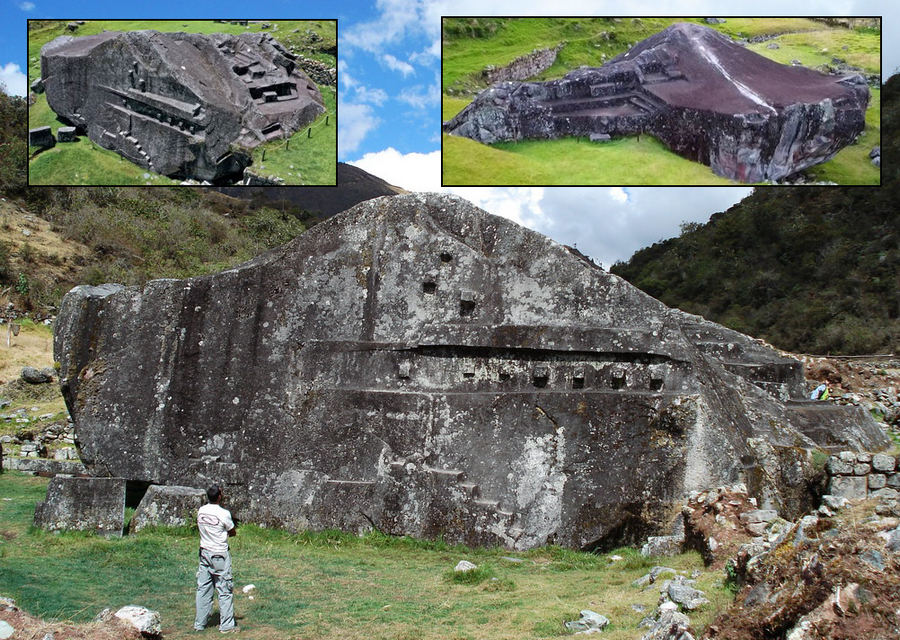
From an archaeological and chronometric perspective, the Sayhuite Monolith and its surrounding sanctuary are securely dated to the late Imperial Inca period, spanning the 15th to early 16th centuries AD (circa 1438–1532 AD). During this era, particularly under the transformative reigns of Sapa Inca Pachacuti and his successors, the Inca state expanded rapidly and undertook mᴀssive infrastructure projects centered on agricultural terracing and hydraulic engineering. Radiocarbon dating of organic material from adjacent stratigraphic layers, combined with stylistic comparisons of surrounding ceremonial masonry, firmly integrates the monolith into the zenith of Inca territorial consolidation prior to the Spanish conquest.
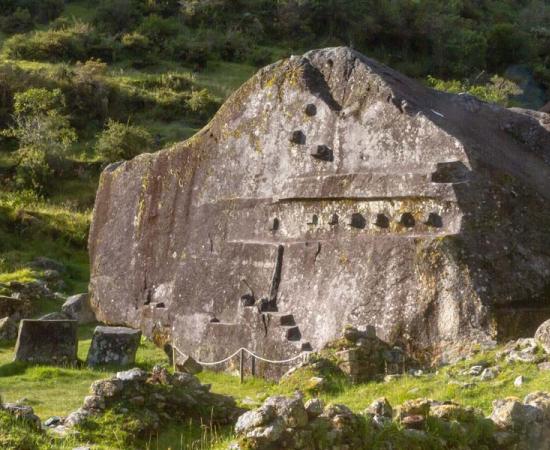
The physical material of this monument consists of an enormous, single granite boulder measuring roughly four meters in length, three meters in width, and over two meters in height. The technical execution of the carvings displays extraordinary craftsmanship: ancient stonemasons used stone hammers made of dense diorite or hemaтιтe alongside abrasive sands to painstakingly carve over 200 distinct geometric, architectural, and zoomorphic figures into the upper surface. The carvings feature miniature representations of agricultural terraces, stairways, temples, channels, and pools, intermingled with sculpted relief figures of native fauna such as felines, frogs, snakes, and monkeys. Small interconnecting grooves and channels run throughout the top of the stone, specifically engineered so that water poured at the highest point cascades down through the miniature canals and miniature agricultural terraces.
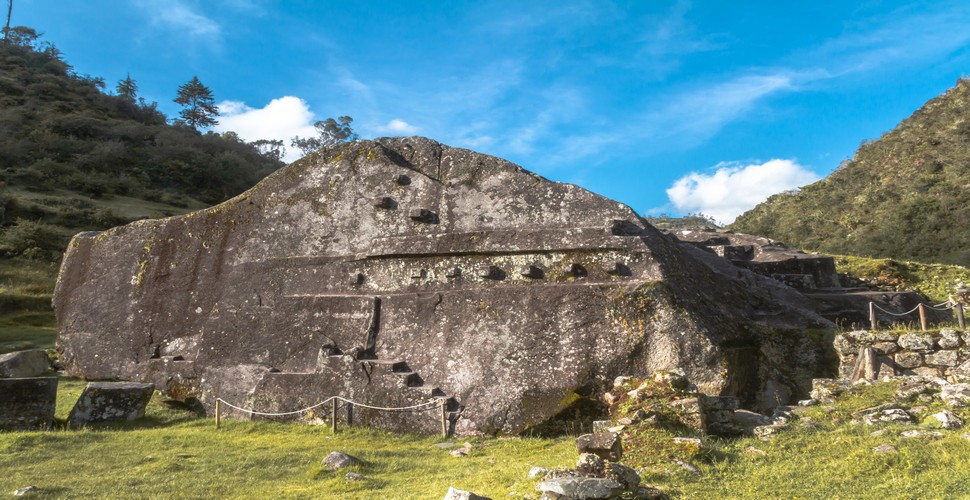
Functionally and symbolically, archaeologists interpret the Sayhuite Monolith as a dual-purpose artifact: an advanced 3D hydraulic scale model and a sacred ritual site dedicated to water worship (sacred huaca). As a practical tool, Inca engineers likely used the stone as an experimental scale model to test fluid dynamics, water flow rates, and irrigation channel designs before executing full-scale canal systems across the complex topography of the Sacred Valley. Symbolically, water was considered a divine, life-giving element in Inca cosmology (Cocha or water worship); pouring liquid over the carved animals—many of which were ᴀssociated with rain and fertility, such as frogs and felines—served as a ceremonial invocation for abundant rainfall and agricultural prosperity across the empire.
Systematic archaeological exploration and documentation of the Sayhuite site have been led by Peruvian heritage authorities, notably the Ministerio de Cultura del Perú (formerly the Insтιтuto Nacional de Cultura), alongside international research teams. Early 20th-century explorations brought the site to global academic attention, while modern conservation programs have focused on 3D pH๏τogrammetric mapping, laser scanning, and environmental preservation to protect the delicate relief carvings from weathering. Today, the Sayhuite Monolith remains protected as part of Peru’s national cultural patrimony, continuing to offer invaluable insights into the sophisticated intersection of ancient science, ritual, and landscape architecture in the Andes.
✓ Ryan Mitchell
The remarkable Sayhuite Monolith, located at the Sayhuite archaeological site in the Abancay Province of the Apurímac Region, Peru, stands as one of the most intriguing and…