The Legend of the Giant Skull: Analyzing Mythological Imagery, Digital Art, and Archaeological Reality
The visual depiction of colossal human or humanoid remains discovered in remote, overgrown environments has long captured the global imagination, frequently surfacing in folklore, alternative history circles, and digital media. The accompanying image, portraying explorers standing in awe before a monumental skull embedded in a dense jungle landscape, represents a powerful convergence of adventure mythology and modern computer-generated imagery. In the realm of public perception, such imagery invokes grand tropes of lost civilizations, forgotten giants, and dramatic archaeological discoveries. However, from a rigorous scientific and archaeological perspective, such visual representations must be critically examined to distinguish between fantastical creative expressions and the actual physical realities of the human fossil record.
From a chronological and scientific standpoint, there is no historical or evolutionary period in which human beings—or any closely related hominin species—reached the multi-story proportions depicted in this rendering. The biological timeline of human evolution, spanning millions of years from early australopithecines to modern Homo sapiens, demonstrates strict anatomical and physiological limits on skeletal scale governed by biomechanical laws, square-cube scaling, and metabolic constraints. While prehistoric hominins exhibited regional morphological variations and robust skeletal traits, real-world paleontological discoveries never yield monolithic skeletal anomalies of this magnitude. Therefore, images depicting hyper-scaled anatomical remains belong entirely to the domain of speculative fiction rather than chronologically secured archaeological history.
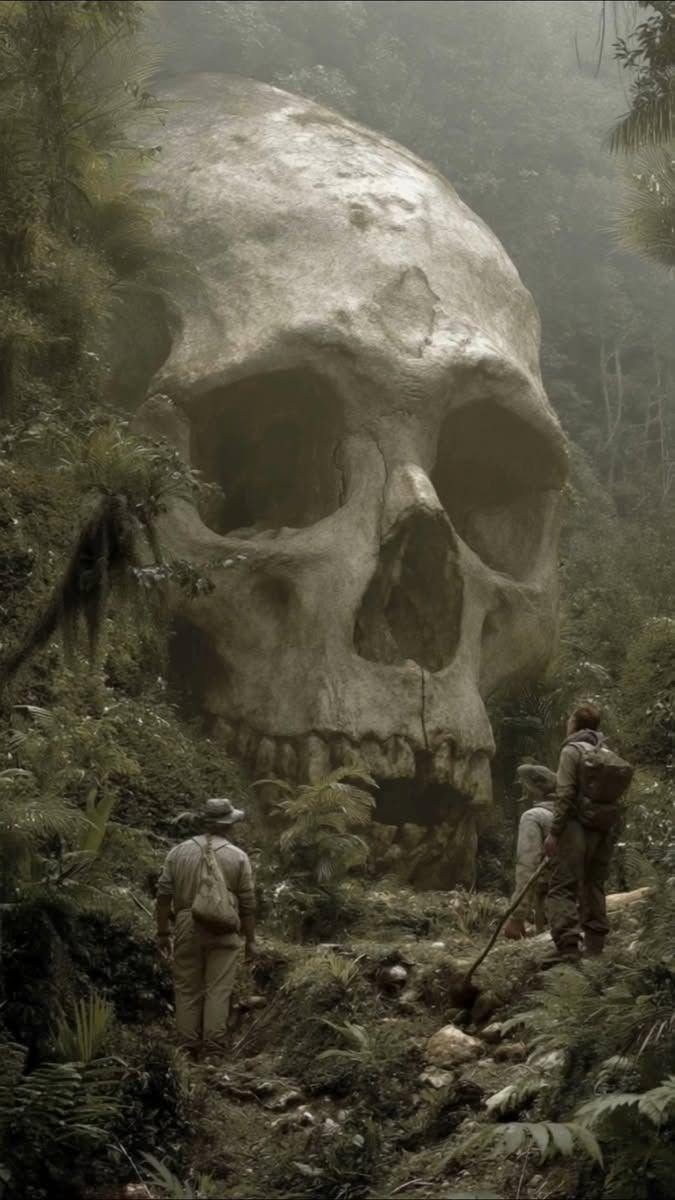
The material composition and manufacturing details of this striking visual point directly toward modern digital creation rather than physical craftwork, stone carving, or fossilization. Unlike genuine stone-carved megaliths, rock-cut architecture, or authentic fossilized bone beds encased in sedimentary matrix, the object in the image displays the smooth textural gradients, organic weathering patterns, and lighting characteristic of advanced AI generation or 3D rendering software. The surrounding jungle, the textured bone-like surface of the skull, and the human figures interacting with it are digitally synthesized elements designed to evoke a sense of scale, wonder, and mystery, lacking any physical substrate or tangible material craftsmanship to analyze.
The symbolic meaning and cultural function of such imagery center on humanity’s enduring fascination with the unknown, the sublime, and the concept of a primordial world inhabited by тιтans. Throughout history, ancient peoples encountering oversized fossilized bones of prehistoric megafauna—such as woolly mammoths, mastodons, or extinct whales—frequently wove them into mythologies featuring giants, demigods, or mythical ancestors. In contemporary media, visual tropes of giant artifacts serve a purely entertainment-driven or speculative function, tapping into popular culture’s appeтιтe for lost worlds, pulp adventure tropes, and the rewriting of conventional history.
Because this image is a modern digital creation rather than a documented archaeological find, it lacks any ᴀssociation with professional excavation teams, scientific insтιтutions, or historical discoverers. Real archaeological and paleontological discoveries—such as hominin fossils unearthed in East Africa, the Denisovan caves of Siberia, or Neanderthal sites across Europe—are meticulously documented through stratigraphy, radiocarbon dating, and peer-reviewed fieldwork by certified researchers. Ultimately, while viral images of colossal remains inspire creative storytelling and feed the imagination, they stand apart from the empirical methods of archaeology, which uncovers the true, deeply complex story of human history through tangible material evidence.
✓ hoangduc
The visual depiction of colossal human or humanoid remains discovered in remote, overgrown environments has long captured the global imagination, frequently surfacing in folklore, alternative history circles,…