The Lithic Shoal: Petroglyphs of the Ancient Seafarers
From a maritime archaeological perspective, the rock art panel in Vesterålen represents a vital link between prehistoric terrestrial life and the bountiful marine ecosystems of the North Atlantic. Situated on a vertical metamorphic rock face overlooking the shoreline, this site is part of a larger network of Arctic rock art traditions. Unlike inland hunter-gatherer sites that focus on reindeer or elk, this “lithic gallery” is positioned specifically to interact with the coastal horizon. Archaeologists have determined that during the Neolithic period, sea levels were significantly higher, meaning these carvings would have been situated just above the high-tide mark, effectively “swimming” at the water’s edge and serving as a permanent record of the community’s primary food source.

The “materiality” of this artifact consists of hard, dark-grey gneiss, a metamorphic rock capable of withstanding millennia of Arctic wind and salt spray. The “craftsmanship” involved is a technique known as “pecking” or “pitting,” where a hard stone tool (a hammerstone) was used to repeatedly strike the cliff face, removing the dark, oxidized outer layer to reveal the lighter, unweathered stone beneath. The precision of the carvings is remarkable; each fish is rendered with a streamlined body, distinct caudal fins, and dorsal outlines. The thin, flowing lines connecting the fish suggest the movement of water or perhaps prehistoric fishing nets, showcasing an advanced level of artistic abstraction and mechanical understanding of the environment.
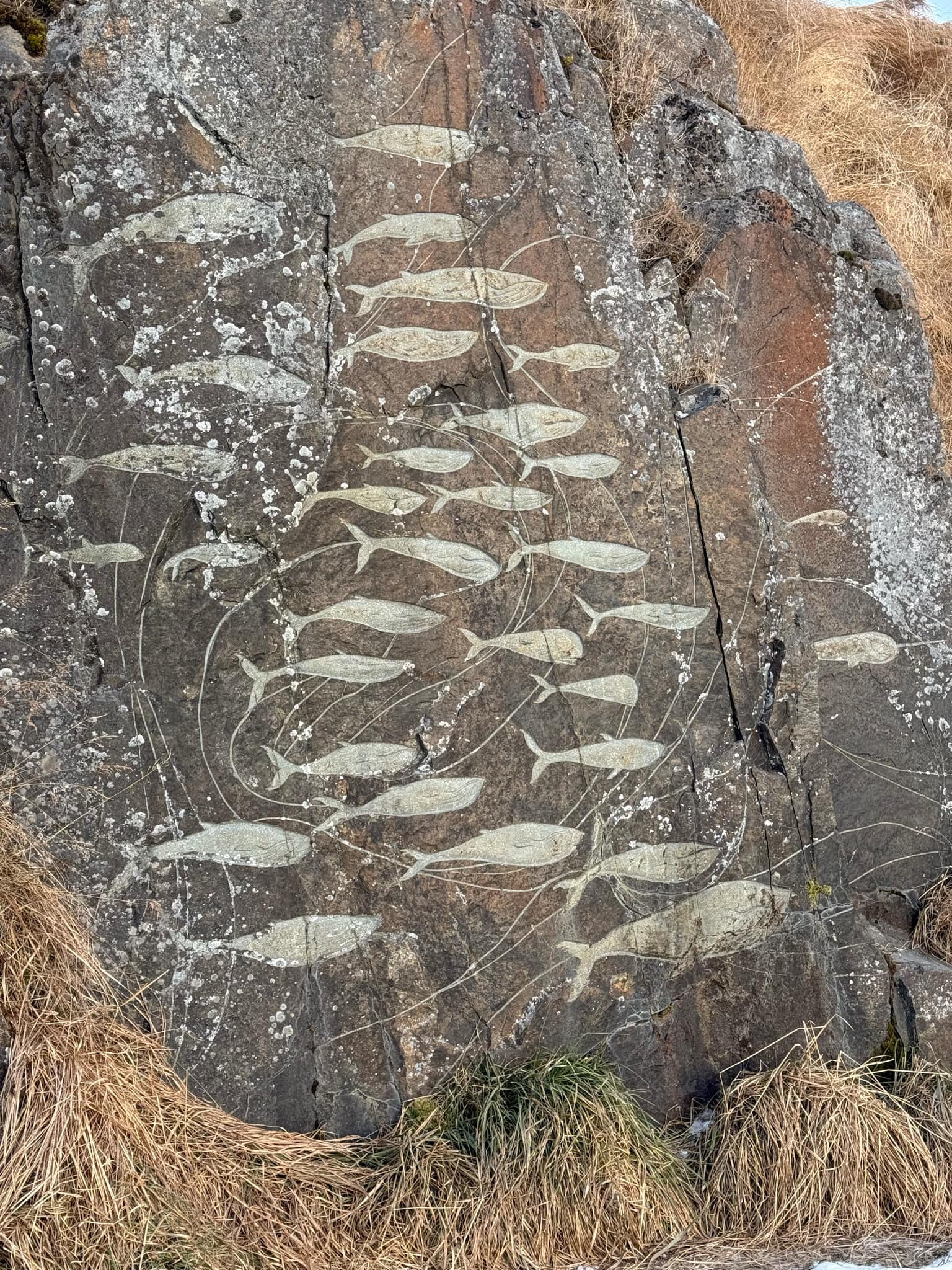
The morphology of the panel depicts a dense shoal of fish, likely representing Atlantic herring (Clupea harengus) or Cod (Gadus morhua), which remain staples of the region today. The figures vary in size, ranging from 15 to 40 centimeters in length, organized in a rhythmic, upward-moving formation that mimics the natural behavior of schooling fish. Archaeologists and marine biologists have noted the anatomical accuracy of the “forked” tails and the lack of exaggerated features, which suggests that the creators were not drawing from imagination but from intimate, daily observation. The spatial arrangement creates a sense of “dynamic kinesis,” where the entire cliff face appears to be in motion, reflecting the abundance of life in the Norwegian fjords.

The primary function of this artifact likely transcended mere decoration, serving as a site for “sympathetic magic” or ritual navigation. In many ancient maritime cultures, depicting prey in large numbers was believed to ensure a successful harvest and the return of the seasonal migrations. By carving these images into the “bones of the earth” (the cliffs), the ancient seafarers were perhaps establishing a spiritual contract with the sea. Additionally, the panel may have served a practical pedagogical purpose, acting as a landmarks or “visual maps” for pᴀssing canoes, signaling that these specific waters were rich in resources or marking territorial boundaries between different seafaring clans.
The site was formally documented in the mid-20th century by researchers affiliated with the Tromsø Museum and the Directorate for Cultural Heritage in Norway (Riksantikvaren). While local inhabitants had known of the “fish rocks” for generations, it was the systematic mapping by Norwegian archaeologists that placed the Vesterålen petroglyphs into the global context of circumpolar rock art. Today, the site is a protected cultural monument. Modern conservation efforts focus on preventing the growth of lichen and moss that can obscure the carvings, using 3D laser scanning to preserve the “digital footprint” of the shoal. This ensures that the legacy of these ancient fishers remains visible as a bridge between the prehistoric past and the modern blue economy of the North.
✓ hoangduc
From a maritime archaeological perspective, the rock art panel in Vesterålen represents a vital link between prehistoric terrestrial life and the bountiful marine ecosystems of the North…