The Sentinels of Nazareth: Ritualistic Resonance and the Dawn of Symbolic Thought in Qafzeh Cave
The subterranean silence of Qafzeh Cave, a limestone sanctuary nestled near the ancient horizons of Nazareth, has surrendered a series of osteological enigmas that redefine the chronological boundaries of human consciousness. Dating to a staggering epoch between 92,000 and 100,000 years ago, the fossilized remains of early Homo sapiens unearthed here represent the world’s oldest known intentional burials, serving as a biological bridge between raw survival and the emergence of the metaphysical mind. These are not the haphazard leavings of a nomadic species but a meticulously organized necropolis where the deceased were laid to rest with a level of intentionality that suggests a profound conceptual grasp of mortality. The anatomical modernity of these specimens, when analyzed against the backdrop of the Middle Paleolithic, indicates that the transition toward symbolic thought was not a sudden explosion but a slow, smoldering fire that was already burning bright in the Levant long before the first cave paintings of Europe.
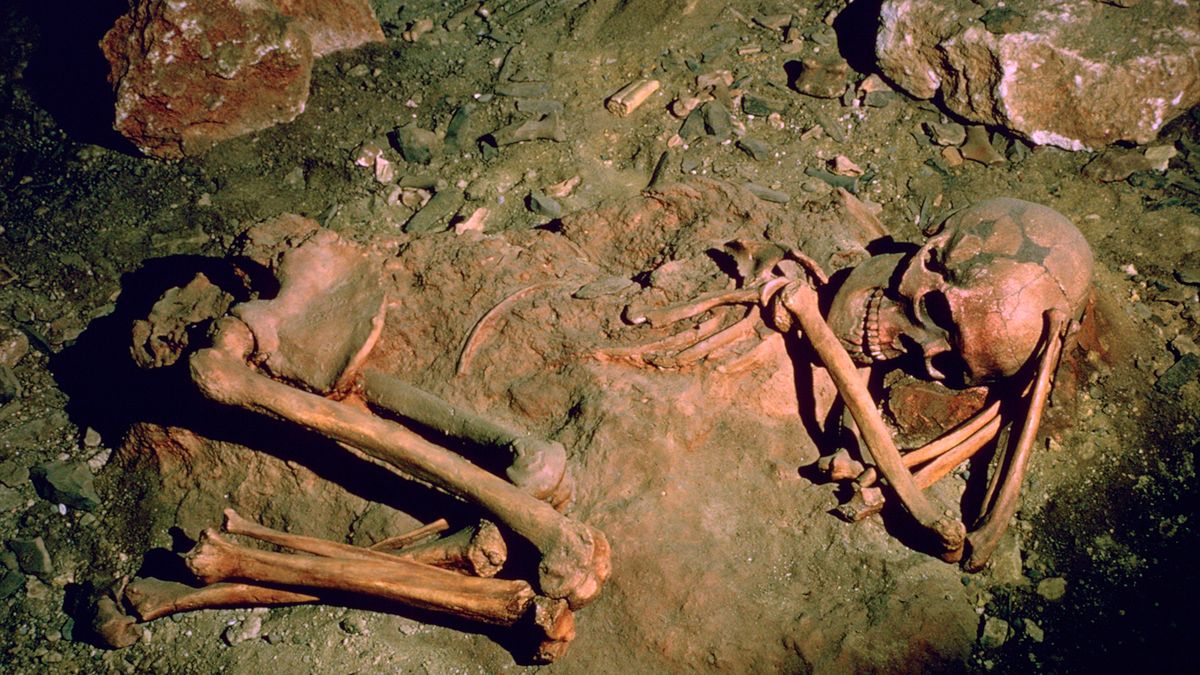
Within the iron-stained silts of the cave floor, researchers identified a specific burial designated as Qafzeh 11, where a young adolescent was found interred with a mᴀssive pair of fallow deer antlers positioned carefully across the chest. This deliberate inclusion of grave goods—extending to perforated seashells and ochre-stained implements—functions as a silent archaeological testimony to the performance of specific rites intended to honor the spirit of the departed. The logic of these offerings implies an early form of spirituality or a proto-religion, where the survivors sought to equip the deceased for a journey beyond the physical realm or to signify their enduring status within the social hierarchy of the tribe. This discovery fundamentally pushes back the timeline for the development of modern human cognition, proving that our ancestors possessed the emotional complexity and social bonds required to maintain a cultural memory of their lost community members across a hundred millennia.
From a socio-cultural perspective, the Qafzeh site operates as a critical window into the migration patterns of biologically modern humans as they ventured beyond the African cradle. The logistical coordination required to maintain such a ritual site suggests that these early Levantines lived in highly structured social units, utilizing the cave not merely as a shelter but as a sacred precinct for the expression of their burgeoning humanity. Traces of fire and communal tool-making sites located in the outer chambers indicate that the act of burial was integrated into the daily rhythm of life, creating a persistent connection between the world of the living and the shadows of the ancestors. By expressing their grief through art and ceremony, the people of Qafzeh established the very foundations of the traditions and behaviors that define our species today, demonstrating that the capacity for wonder and the need for ritual are woven into the very fabric of the human genetic code.

Ultimately, the Qafzeh burials serve as a monumental rebuke to the narrative that prehistoric life was a brutal, unthinking struggle for existence. The image of these ancient skeletons, preserved in their final, honored states, invites a re-evaluation of the ancient origins of human empathy and symbolic expression. Every mineralized bone and every carefully placed antler stands as a sentinel of a forgotten epoch, a time when the first modern humans looked at the stars and the silence of death and chose to respond with dignity and ceremony. As paleoanthropologists continue to decode the isotopic signatures and cultural artifacts of this sacred cave, it becomes increasingly clear that we are looking at our own reflection across the vastness of time. Qafzeh is no longer just a site of historical data; it is the birthplace of the human soul, a place where the ancestors first claimed their place in the universe by burying their ᴅᴇᴀᴅ with the hope of an eternal resonance.

✓ tuongvien
The subterranean silence of Qafzeh Cave, a limestone sanctuary nestled near the ancient horizons of Nazareth, has surrendered a series of osteological enigmas that redefine the chronological…