Transcontinental Motifs: A Comparative Archaeological Analysis of Winged Anthropomorphs in Japan, Utah, and Azerbaijan
The global distribution of ancient rock art featuring striking anthropomorphic figures with wing-like appendages has long fascinated both professional researchers and alternative historians. As illustrated by comparisons between petroglyphs from the Fugoppe Cave in Japan, Nine Mile Canyon in Utah, and the Gobustan Rock Art Cultural Landscape in Azerbaijan, widely separated geographical regions showcase remarkably similar artistic motifs of purported winged or soaring enтιтies. From an archaeological standpoint, these sites provide a profound case study in visual culture, raising complex questions regarding independent cultural evolution versus transoceanic contact. Examining these panels requires rigorous contextualization of their respective material substrates, manufacturing techniques, and chronological frameworks rather than relying on superficial visual parallels.
The chronology and geographical contexts of these three distinct sites span vast expanses of both time and space, discounting any unified contemporary origin. The Japanese petroglyphs, located within the Fugoppe Cave in Hokkaido, are generally attributed to the Epi-Jomon culture, dating approximately from the 1st to 7th centuries CE. In contrast, the North American examples found in Nine Mile Canyon, Utah, were primarily created by the indigenous Fremont culture and later Ute populations, with rock art panels generally dated between 950 and 1250 CE. Meanwhile, the oldest of the group, situated in the Gobustan rock shelter region of Azerbaijan, features petroglyphs stretching back from the Upper Paleolithic through the Bronze Age, with some panels estimated to be between 5,000 and 10,000 years old.
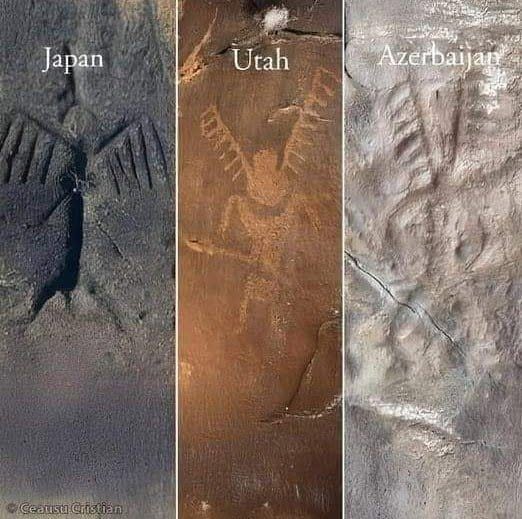
The material execution and physical composition of these petroglyphs are intrinsically tied to the local geology of each respective region. In the maritime coastal environment of Hokkaido, the Fugoppe Cave carvings are incised into soft volcanic tuff and sandstone walls using stone or early metal chisels. In Utah’s arid Nine Mile Canyon, the makers utilized direct pecking, incising, and abrading techniques on dark desert varnish coating vertical sandstone cliffs, exposing the lighter stone underneath. The Gobustan carvings in Azerbaijan were likewise executed by pecking and scraping into hard limestone rock shelters, utilizing the natural contours of the cave walls to give three-dimensional emphasis to the shoulders and outstretched appendages of the figures.
Archaeological interpretations universally ground the meaning and function of these figures in ancient ritual, cosmology, and shamanistic practices rather than literal depictions of flight or extraterrestrial contact. Anthropologists suggest that the “wings” or ray-like appendages often represent ceremonial regalia, such as capes constructed from bird feathers, or serve as spiritual metaphors for the soul’s ability to transcend earthly bounds during trance states. In hunter-gatherer and early agricultural societies, bird symbolism frequently correlated with rain-bringing deities, celestial messengers, or elite shamans mediating between the mortal realm and the supernatural underworld. Thus, the visual grammar reflects shared human preoccupations with spirituality, avian agility, and cosmic hierarchy rather than a universal blueprint.
The documentation and discovery of these disparate archaeological ᴀssets occurred through entirely separate modern investigations over the past two centuries. The Gobustan petroglyphs were formally identified and cataloged starting in the 1930s by Azerbaijani archaeologist Ishak Jafarzade; the Utah rock art sites have been systematically recorded by insтιтutions like the University of Utah and federal preservation bureaus; and the Fugoppe Cave was famously brought to light in 1950 by a local Japanese student before drawing professional excavation teams. Modern archaeology views these panels not as proof of ancient global connectivity, but as a compelling testament to convergent cultural expression, where humanity independently used stone surfaces to project its deepest spiritual aspirations.
✓ hoangduc
The global distribution of ancient rock art featuring striking anthropomorphic figures with wing-like appendages has long fascinated both professional researchers and alternative historians. As illustrated by comparisons…