Unearthing the Citadel of Erbil: Millennia of Stratified Urban History
Dating back over six millennia, the Erbil Citadel stands as one of the oldest continuously inhabited settlements in human history. Rising dramatically as a formidable oval tell in the heart of the Kurdistan Region of Iraq, this archaeological marvel encapsulates layers of civilization stretching from the Neolithic period through the ᴀssyrian, Sasanian, Islamic, and Ottoman eras. The site’s chronological depth is a rare testament to continuous human occupation, where each successive generation built directly upon the architectural debris of their predecessors. From an archaeological perspective, the citadel functions as an open-air stratigraphical archive, offering researchers an uninterrupted timeline of urban evolution, socio-political adaptation, and shifting regional powers in Upper Mesopotamia.

The geographical locus of discovery and continuous existence is situated on a high plateau in the center of modern-day Erbil, historically known as Arbela. The materials utilized in the construction of the citadel’s ancient layers and standing structures predominantly feature traditional mudbrick, baked brick, and local timber, reinforced by centuries of accumulated domestic debris and compacted earth known as occupational fill. The crafting details of the citadel’s outer perimeter are defined by a continuous ring of 19th-century facade houses whose exterior walls merge into a defensive cliff-like barrier, concealing a dense maze of narrow alleyways and courtyard dwellings within. Beneath these visible structures lie deeply buried remains of defensive fortifications, administrative palaces, and religious sanctuaries crafted with sophisticated ancient masonry techniques designed to stabilize the steep slopes of the mound.
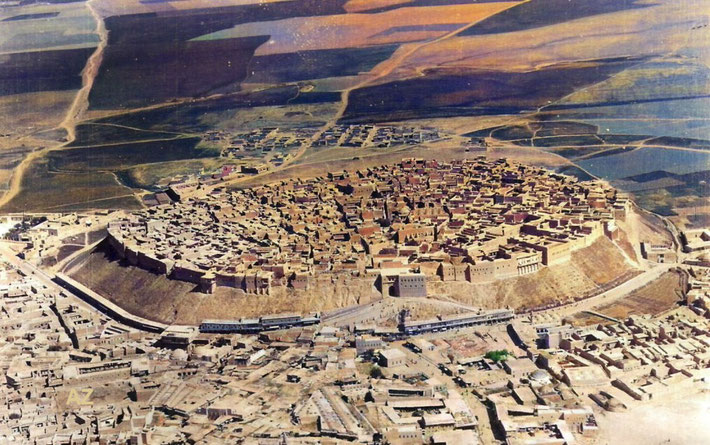
From a functional and sociological standpoint, the citadel served primarily as a fortified acropolis, designed to protect the ruling elite, religious authorities, and civilian populations from recurring regional invasions and sieges. Historically, it functioned as a vital administrative hub and a major religious center dedicated to the worship of Ishtar of Arbela, a paramount deity of the ᴀssyrian empire. Beyond its military and administrative utility, the urban layout—characterized by its distinct radial street pattern and three traditional quarters (Al-Chihana, Al-Saray, and Al-Taik)—fostered a closely knit community structure. The spatial organization reflects a deep synthesis of defensive necessity, social hierarchy, and communal living, ensuring that the inhabitants could sustain themselves during periods of external conflict.

The archaeological exploration and systematic documentation of the Erbil Citadel have been driven by international collaborations and specialized preservation bodies. Most notably, the High Commission for the Erbil Citadel Revitalization (HCECR), established by the Kurdistan Regional Government, has spearheaded comprehensive archaeological surveys, stabilization efforts, and excavations in partnership with UNESCO and international academic teams. Earlier scholarly interest was sparked by travelers and epigraphists studying ᴀssyrian royal inscriptions mentioning Arbela as a major cultural crossroads. Modern rescue excavations and architectural documentation projects have meticulously peeled back the layers of the mound, recovering invaluable artifacts, ceramic typologies, and structural remains that shed light on the daily lives of ancient Erbil’s inhabitants.

In conclusion, the Erbil Citadel remains an irreplaceable monument of global heritage, bridging the gap between ancient antiquity and modern urban continuity. Its towering presence captures the resilience of human civilization, having weathered the rise and fall of empires while remaining a living heart for the local population. Through ongoing archaeological stewardship, advanced stratigraphical mapping, and careful restoration, the secrets locked within its ancient strata continue to be preserved. Ultimately, the citadel is not merely a relic of the past, but a profound architectural dialogue across millennia, illustrating how ancient communities engineered permanence upon the changing landscape of Mesopotamia.
✓ hoangduc
Dating back over six millennia, the Erbil Citadel stands as one of the oldest continuously inhabited settlements in human history. Rising dramatically as a formidable oval tell…