Unveiling the “Dendera Light”: An Alternative Perspective on Ancient Egyptian Technology
The temple complex of Dendera, situated on the west bank of the Nile in Upper Egypt, is renowned for its intricate and exceptionally well-preserved reliefs, most notably those within the Hathor Temple. While the majority of these reliefs depict traditional religious rituals and deities, one particular series of carvings in a small, crypt-like chamber has captured the imagination of alternative historians and fringe archaeologists. This relief, often termed the “Dendera Light,” has been interpreted by some, including the prominent Austrian author and pseudo-archaeologist Erich von Däniken, as definitive proof that the ancient Egyptians possessed advanced technological knowledge, specifically pertaining to electricity and lighting. The images, as presented in this collage, form the basis of a highly controversial hypothesis that challenges the established narrative of ancient capabilities.

The core of the “Dendera Light” hypothesis rests on a visual interpretation of the primary relief. In this carving, a group of figures is seen supporting an elongated, bulbous object. At one end of this object, which proponents liken to an oversized Crookes tube or a modern incandescent light bulb, a serpent-like form emerges, interpreted by believers as an electrical discharge or filament. A cable-like structure connects this bulb to a smaller device, identified by proponents as an electrical source or battery (sometimes referenced alongside the Baghdad Battery). Further, figures in the relief are ᴀssigned specific roles within this proposed technological process, such as a priest monitoring the equipment and a protective deity, all carefully documented with numbered annotations in the accompanying text.
Dating back to the Ptolemaic period, specifically during the reign of Pharaoh Nectanebo II (c. 360-343 BCE) or slightly later, the reliefs in the Hathor Temple were created by master craftsmen using traditional Egyptian carving techniques on limestone. The “Dendera Light” images are a striking example of the period’s skill, rendered with a precision and detail that allows for such imaginative reinterpretation. The relief work is technically impressive, showcasing the ability of ancient artisans to create complex scenes with both human and symbolic figures, suggesting a narrative purpose far exceeding a simple depiction of a lighting apparatus. Archaeologists maintain that this narrative is purely mythological, part of a complex ritual of divine rebirth and solar regeneration.
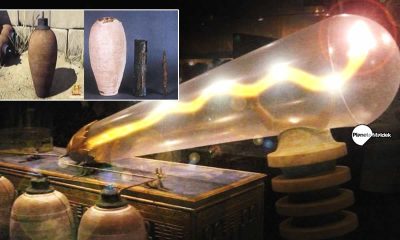
The archaeological and historical consensus regarding the “Dendera Light” is unequivocal: it is not evidence of ancient electricity. Mainstream scholars interpret the relief within the context of ancient Egyptian cosmology and mythology. The elongated “bulb” is identified as a stylized representation of the night sky, or the womb of the goddess Nut. The serpent inside is not an electrical discharge but a manifestation of the god Harsomtus (the young Horus), often depicted as a snake emerging from a lotus flower (the “lamp socket”), symbolizing the rebirth of the sun at dawn. The “cable” is the stalk of the lotus, and the figure labeled as a “priest” is more accurately a depiction of Harsomtus himself, with other figures being part of the retinue of protective deities and priests involved in the ritual.
Ultimately, the “Dendera Light” serves as a potent example of how ancient artifacts can be re-contextualized to fit modern narratives. While the relief itself is a beautiful and historically significant example of Ptolemaic art, the interpretation presented in this collage—the “electric light bulb” theory—is a product of 20th-century imagination, lacking any supporting evidence from archaeology, textual analysis, or contemporary sources. The carvings are a complex theological tableau, not a schematic for electrical technology. However, the persistence of this alternative theory highlights the enduring fascination with ancient mysteries and the powerful human desire to see the past as advanced, perhaps more like our own civilization than previously understood.
✓ hoangduc
The temple complex of Dendera, situated on the west bank of the Nile in Upper Egypt, is renowned for its intricate and exceptionally well-preserved reliefs, most notably…