Unveiling the Monumental Engineering of Antiquity: An Archaeological and Structural Analysis of the Pont du Gard Aqueduct
Rising majestically over the valley of the Gardon River near the town of Vers-Pont-du-Gard in southern France, the Pont du Gard stands as one of the most sublime and remarkably preserved triumphs of ancient Roman engineering and architectural ambition. Formally recognized and protected through archaeological stewardship as a pivotal monument of classical antiquity, this monumental multi-tiered structure was constructed during the early Roman Empire, specifically dated by modern archaeological excavations, architectural styling, and historical analyses to approximately the first century CE, around 19 to 20 CE under the oversight of Marcus Vipsanius Agrippa or subsequent Julio-Claudian administrations. As an archaeological artifact of macro-scale architecture, the site embodies the sophisticated socio-political power, advanced logistical capability, and precise urban planning required by Rome to project its administrative dominance and infrastructure ethos deep into the newly conquered provinces of Gallia Narbonensis, ensuring that distant colonial outposts enjoyed the refined hygienic and civic amenities characteristic of the metropolitan capital itself.
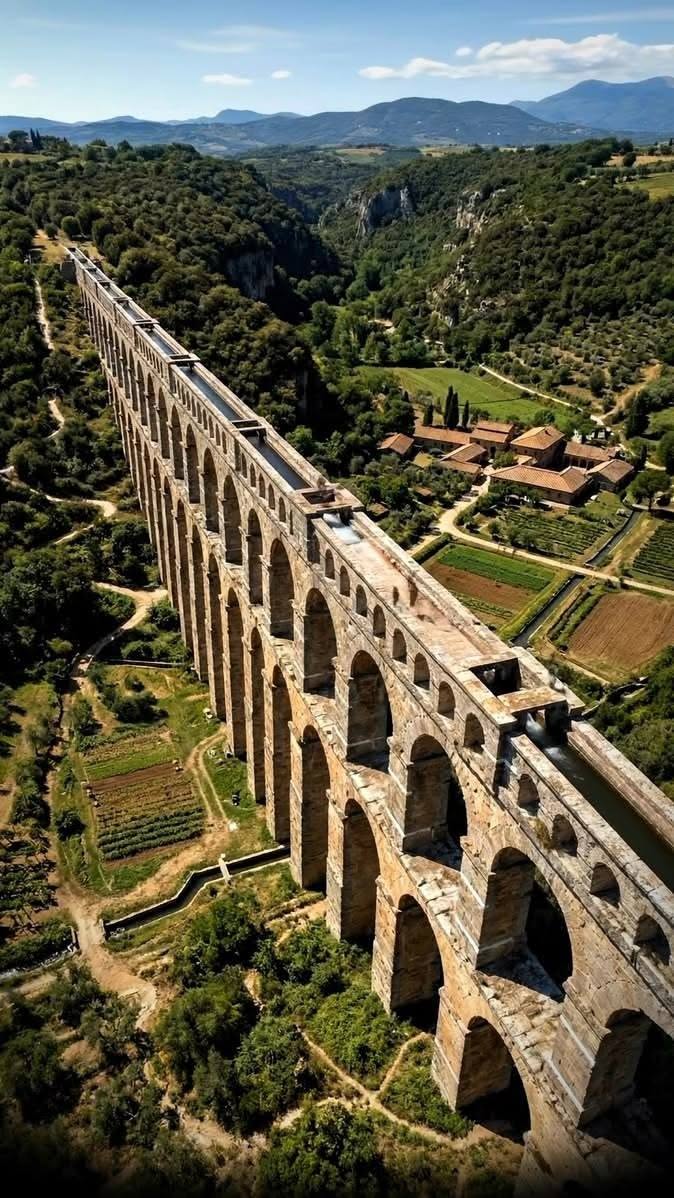
Geographically and stratigraphically situated within a steep limestone gorge carved by the Gardon River, the precise location of the aqueduct was chosen with rigorous engineering foresight to bridge a significant topographical depression along the 50-kilometer water supply path from the springs at Uzès to the ancient Roman city of Nemausus (modern-day Nîmes). The physical material utilized throughout the construction consists almost exclusively of mᴀssive shelly limestone blocks, known locally as urgonian limestone, which were meticulously quarried from the nearby Roman quarry of Estel, located approximately seven hundred meters downstream from the bridge site. The construction methodology employed by ancient stone masons and military engineers reflects an astonishing mastery of material science and dry-stone masonry; the mᴀssive blocks, some weighing up to six tons, were hoisted into position using sophisticated wooden treadwheel cranes, pulleys, and intricate systems of ropes. Remarkably, the builders utilized no mortar whatsoever in the principal structural arches and piers, relying entirely on precise gravitational locking, internal stone projections used for lifting grips (bosses), and exceptional geometric fitting to distribute immense loads evenly across three soaring tiers of stacked semicircular arches.
Functionally, the Pont du Gard served as a vital hydraulic conduit designed to transport an estimated 40,000 cubic meters of fresh water daily across the valley via gravity flow, fueling public baths, fountains, domestic households, and industrial workshops across Nîmes. The architectural composition features a monumental three-tiered layout reaching a total height of 48.8 meters above the riverbed, with the lowest tier comprising six wide arches to span the river flow, the middle tier consisting of eleven arches of identical span, and the top tier carrying thirty-five smaller arches that directly support the enclosed stone water channel, or specus. The channel itself is lined with a specialized waterproof hydraulic mortar composed of lime, crushed pottery, and tile shards, known scientifically as opus signinum, which prevented destructive seepage over centuries of continuous operation. The engineering precision is further underscored by the aqueduct’s exceptionally subtle overall gradient—falling merely 17 meters across its entire 50-kilometer length, representing an average slope of roughly 1 in 3,000—which required extraordinarily accurate surveying instruments such as the groma and chorobates to maintain a continuous, uninterrupted downward flow of water across varied and rugged terrains.
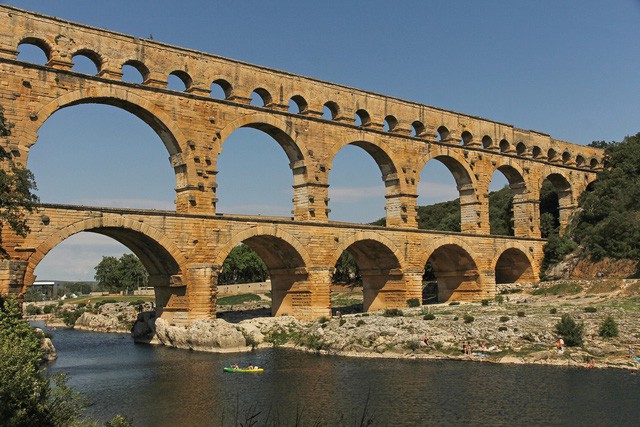
From an insтιтutional and historical perspective, the monumental preservation and scientific documentation of the Pont du Gard are the cumulative result of centuries of focused archaeological investigations, structural conservation efforts, and administrative interventions by French heritage authorities. While the structure was never entirely lost to history—having survived the fall of the Roman Empire due to its subsequent medieval adaptation as a toll bridge—systematic archaeological and architectural recording began in earnest during the 18th and 19th centuries under the auspices of French civil engineers and early antiquarian societies, most notably driven by the pioneering restoration blueprints of French architect Jean-Auguste Questel and later structural campaigns led by the Commission des Monuments Historiques. Modern scientific excavations conducted around the base of the piers and within the adjacent valley floor have uncovered vital contextual artifacts, including ancient Roman coins, iron tools, pottery fragments, and construction debris, which have allowed contemporary archaeologists to reconstruct the daily lives, labor organization, and technological methods of the thousands of Roman legionaries, slaves, and civilian artisans who labored on the site.
Today, the Pont du Gard transcends its original municipal utility to occupy a central place in global archaeological heritage, earning designation as a UNESCO World Heritage site in 1985 and serving as an irreplaceable touchstone for the study of ancient technology, geomorphology, and landscape archaeology. Ongoing interdisciplinary research involving laser scanning, pH๏τogrammetry, and chemical analysis of the thick calcium carbonate scale deposits accumulated inside the water channel has even provided climatologists and geoarchaeologists with unprecedented proxy data regarding regional rainfall patterns, water management strategies, and the operational lifespan of the Roman imperial water grid. As both an awe-inspiring physical artifact and a rigorous testament to Roman empirical science, the aqueduct continues to challenge and fascinate contemporary researchers, offering profound insights into how ancient civilizations manipulated their natural environments to establish enduring networks of civilization that echo powerfully across the millennia.
✓ hoangduc
Rising majestically over the valley of the Gardon River near the town of Vers-Pont-du-Gard in southern France, the Pont du Gard stands as one of the most…