Whispers from the Pavement: An Archaeological Analysis of Classical Roman Mosaic Art
Among the most visually stunning and enduring legacies of classical antiquity are mosaic floors that once adorned the luxurious villas, bathhouses, and public civic buildings of the Roman Empire. Dating primarily back to the Imperial Period, spanning from the 1st century BCE to the 3rd century CE, these intricate floor pavements transformed utilitarian architecture into breathtaking canvases of colored stone. The featured archaeological remains showcase a masterfully executed mosaic floor fragment, highlighted by a central figurative panel depicting a stylized female bust—likely a mythological water deity or personification of nature—surrounded by geometric borders and naturalistic motifs. This artifact offers modern scholars a unique lens through which to explore the artistic expressions, technical capabilities, and aesthetic values of provincial Roman elite society.
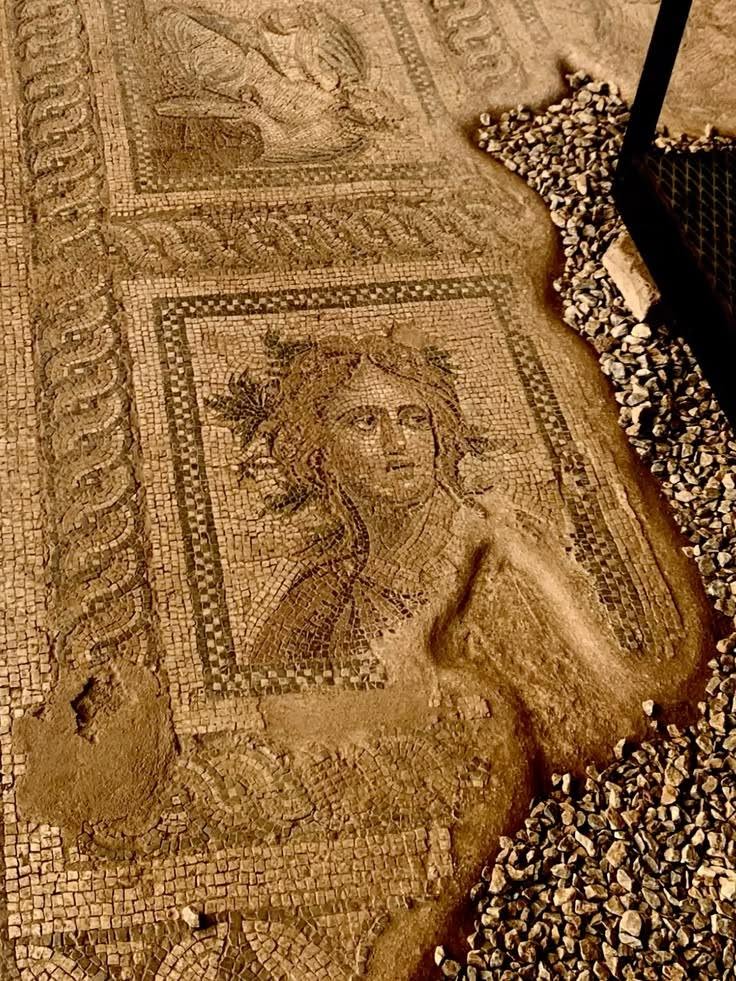
Archaeological recovery of such expansive mosaic pavements typically occurs during controlled excavations of ancient urban centers, aristocratic country estates (villae rusticae), or trading ports across the Mediterranean basin and Near East. Often preserved beneath layers of protective alluvial sediment, volcanic ash, or structural collapse, these floors maintain their primary archaeological context when systematically unearthed. The precise stratigraphic positioning of the mosaic helps archaeologists date the surrounding architectural phases accurately, providing chronological markers for the construction, remodeling, or destruction of the building. Finding such mosaics intact within domestic or public contexts demonstrates the widespread integration of high art into everyday architectural spaces during the height of Roman dominance.

The physical construction of these pavements relied on meticulous craftsmanship and durable materials, utilizing thousands of tiny hand-cut stone cubes known as tesserae. These tesserae were crafted from locally sourced or imported colored stones, including fine limestone, marble, terracotta, and occasionally glᴀss paste to achieve vibrant shades of blue, red, ochre, and deep black. Artisans laid these small cubes into a thick bed of high-quality mortar, typically structured over multiple preparatory layers—including a coarse foundation (statumen), a sub-layer of broken pottery and lime (rudus), and a fine bedding layer (nucleus)—to ensure structural stability. The mastery of the mosaicist is evident in the subtle shading (gradation), contouring, and perspective used to render human features, hair strands adorned with leaves or ribbons, and linear geometric framing without the use of painted lines.

Beyond their obvious aesthetic appeal, these mosaic floors served profound functional and symbolic roles within classical buildings. In reception rooms (oeci) or dining areas (triclinia), elaborate figurative centerpieces were deliberately positioned to impress visiting guests, acting as visual statements of the owner’s wealth, education, and cultural refinement. Mythological scenes, personifications of the seasons, or water divinities often carried deeper apotropaic meanings—warding off evil spirits or invoking prosperity, fertility, and protection over the household. Furthermore, the geometric and guilloche borders served to zone large interior spaces, guiding the movement of inhabitants and highlighting the primary focal points of the room’s architectural layout.
The scientific study, preservation, and documentation of such fragile floor mosaics are spearheaded by multidisciplinary teams of classical archaeologists, conservators, and epigraphers working under insтιтutions such as the Ministry of Culture, foreign archaeological insтιтutes, and university research programs. Pioneers of modern classical archaeology established standardized methodologies for lifting, cleaning, and chemically stabilizing ancient tessellated pavements to prevent structural decay upon exposure to modern air and humidity. Through meticulous troweling, micro-excavation, pH๏τogrammetry, and chemical analysis of the mortar compounds, contemporary archaeological organizations continue to safeguard these priceless remnants, ensuring that the remarkable artistry of ancient craftsmen remains accessible for future historical research.
✓ Ryan Mitchell
Among the most visually stunning and enduring legacies of classical antiquity are mosaic floors that once adorned the luxurious villas, bathhouses, and public civic buildings of the…