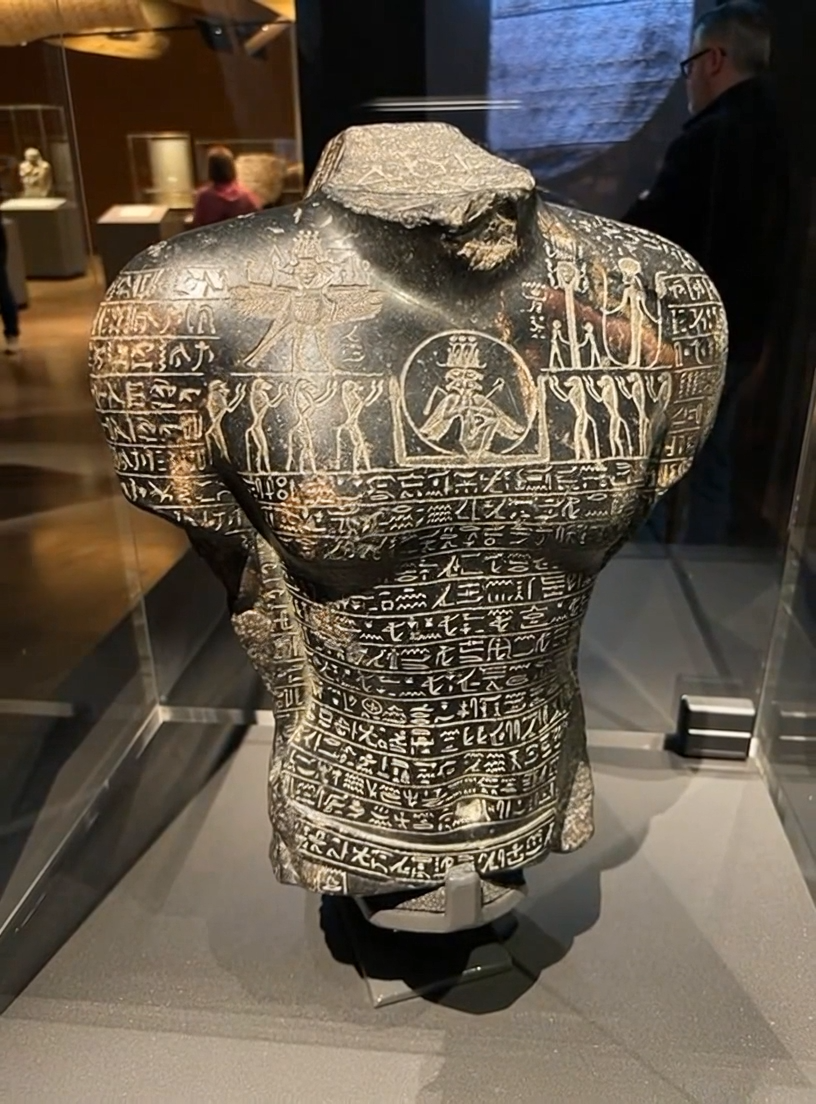
The artifact depicted is a remarkable example of Late Period Egyptian craftsmanship, specifically dating to the 30th Dynasty (approx. 380–342 BC), likely during the reign of Nectanebo II. While this specific torso resembles the famous Metternich Stela, it belongs to a category of objects known as “Magical Stelae” or Cippi of Horus. Most such artifacts have been recovered from the vicinities of major temple complexes in Heliopolis or Alexandria, though many were later moved during the Graeco-Roman period. This particular piece represents the pinnacle of Egyptian basalt carving just before the conquest of Alexander the Great, reflecting a time when traditional Egyptian religious art sought to condense vast theological protections into singular, portable, or monumental stone forms.
From a petrographic and archaeological standpoint, the artifact is carved from fine-grained black basalt (or occasionally dark greywacke), materials prized by Egyptian artisans for their durability and symbolic connection to the fertile silt of the Nile and the concept of rebirth. The level of craftsmanship is extraordinary; the torso is polished to a near-metallic sheen, providing a stark contrast to the intricate incised relief work. The surface is entirely consumed by “horror vacui”—a fear of empty space—filled with miniature hieroglyphic inscriptions and pantheistic deities. The precision required to engrave such dense, microscopic texts into a material as hard as basalt (measuring 6 on the Mohs scale) suggests the use of specialized copper or bronze abrasive tools combined with quartz sand, a testament to the advanced lithic technology of the 30th Dynasty workshops.

The iconography on the chest and back serves as a dense theological “map” of protection. Centrally featured is the “Horus on the Crocodiles” motif, though here it is integrated into the anatomical form of the torso. We observe various manifestations of the sun god, protective deities like Bes (indicated by the grotesque mask often appearing at the top of such stelae), and scenes of the young Horus being healed by Isis and Thoth. The inscriptions are not merely decorative; they are magical spells and incantations designed to repel venomous creatures—snakes, scorpions, and crocodiles. The figures are carved in a “sunken relief” style, ensuring that even as the stone surface might weather over millennia, the sacred spells would remain legible and powerful, maintaining their “voice” for eternity.

In the context of Egyptian archaeology, this object was far more than a statue; it was a functioning medical-magical device. It served as a “healing station” for the public or the priesthood. The primary utility involved a ritual of water libation: a person suffering from a sting or bite, or seeking preventative protection, would pour water over the statue. As the water flowed over the sacred hieroglyphs and the images of the gods, it was believed to “absorb” the magical potency of the spells. The water would then be collected at the base and drunk by the patient. This represents a fascinating intersection of clinical medicine, religion, and symbolic magic, where the physical stone acted as a battery for divine energy, accessible to anyone through the medium of water.
The discovery and study of such “magical torsos” are often linked to the early 19th-century expeditions and the subsequent establishment of major Egyptological collections. While the “Metternich Stela” (the most complete version of this type) was discovered in 1828 and gifted to Prince Metternich, fragmentary torsos like the one shown have been unearthed during systematic excavations by the Service des Antiquités de l’Égypte and various European missions in the Delta region. Modern scholars, such as those from the British Museum or the Louvre, have utilized multispectral imaging to study these texts, revealing that many of these statues were part of “Sanatoria” located within temple precincts. These artifacts remain crucial for archaeologists today, as they provide a rare window into the private anxieties and the sophisticated “magical healthcare” system of the ancient Egyptian populace.