HE WAS ONLY 14 — THEN, 70 YEARS LATER, A JUDGE SAID THE TRIAL THAT SENT HIM TO THE ELECTRIC CHAIR HAD VIOLATED HIS RIGHTS 💔
Posted by Team - September 15, 2026
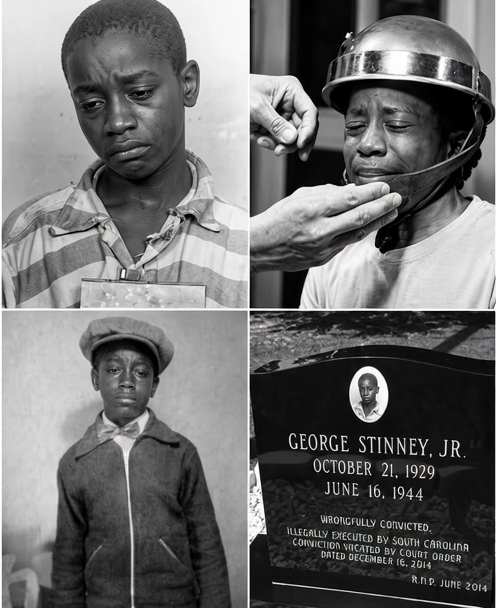
They executed a 14-year-old boy after a trial that lasted only one day. Seventy years later, a judge said the process that sent him to the electric chair had violated his consтιтutional rights.
George Stinney Jr. was fourteen years old.
He was barely five feet tall and weighed around 95 pounds.
He was still a child.
But in the Jim Crow South of 1944, being a Black child could not protect you from a justice system built around racial inequality.
In March 1944, two white girls from Alcolu, South Carolina—11-year-old Betty June Binnicker and 7-year-old Mary Emma Thames—disappeared while out looking for flowers.
The following morning, their bodies were discovered in a water-filled ditch.
The town was horrified.
And authorities quickly focused on George.
Police took him into custody while his parents were away.
His younger sister later said she remembered hiding as officers took George and his brother Johnnie away.
Johnnie was eventually released.
George wasn’t.
He was questioned without his parents present and without a lawyer beside him.
Police said he confessed.
But that alleged confession became one of the most controversial pieces of the entire case.
There was no surviving signed confession in George’s own words.
There was no recording.
And decades later, his family maintained that George was innocent.
His sister Amie said she had been with George around the time the girls disappeared and that they had been near the railroad tracks when the girls pᴀssed by on bicycles.
That account never reached the 1944 jury.
Then the case moved with astonishing speed.
George was arrested in March.
His capital trial began on April 24.
By the end of that same day, his fate had been decided.
The jury was made up entirely of white men.
George’s court-appointed attorney did not present defense witnesses.
His siblings’ account was not presented to the jury.
And no appeal was filed after the conviction.
The jury deliberated for only a few minutes.
Then came the verdict:
Guilty.
George was sentenced to death.
He was fourteen.
His mother pleaded for mercy.
His family was forced from their home after his father lost his job at the local mill.
But the execution remained scheduled.
On June 16, 1944, George was taken to the electric chair.
Only 84 days had pᴀssed since the girls disappeared.
A child had gone from being accused to being executed in less than three months.
South Carolina killed George Stinney Jr. that evening.
He was still fourteen.
For decades afterward, his family carried the memory of what had happened.
They did not simply ask the state to forgive George.
They wanted the conviction itself confronted.
Because a pardon could suggest mercy.
They wanted the court to confront whether the process that condemned him had ever been fair.
Then, seventy years after George’s execution, his case returned to court.
In 2014, surviving members of his family testified.
His sister Amie again described what she remembered.
Experts examined the alleged confession and the quality of George’s legal representation.
The question before Judge Carmen Mullen was not simply whether a modern court could determine who killed the two girls.
It was whether George Stinney had received the consтιтutional protections that should have applied to him in 1944.
The answer was devastating.
Judge Mullen concluded that George’s prosecution had been fundamentally flawed and that his consтιтutional right to due process had been violated.
His conviction was vacated.
Seventy years after South Carolina declared him guilty and executed him, the state court erased that conviction.
But the ruling did not magically reconstruct every missing piece of the 1944 investigation.
It did not identify another person as the killer.
It did not conduct a new murder trial.
It addressed something more fundamental:
The process used to condemn George Stinney was not consтιтutionally acceptable.
And that distinction matters.
Because George did not simply lose his freedom.
He lost his childhood.
He lost every birthday after fourteen.
Every Christmas.
Every graduation.
Every friendship he might have made.
Every career he might have built.
Every ordinary moment that comes with growing older.
A court could vacate a conviction seven decades later.
It could acknowledge the consтιтutional violations.
But it could not give George back a single day.
And there is another reason his story must be told carefully.
Images circulated online claiming to show George inside the electric chair have repeatedly been presented as authentic. Some widely shared images are actually ᴀssociated with the 1991 television film Carolina Skeletons, not documented pH๏τographs of George’s execution.
George’s story does not need invented pH๏τographs.
It does not need fabricated final words.
It does not need mythology.
The historical record is already powerful enough.
Two little girls lost their lives.
And a fourteen-year-old Black boy was condemned by a legal process that, seventy years later, a judge found had violated his consтιтutional rights.
That is the tragedy.
And perhaps the most painful part is the simplest.
George entered the system as a 14-year-old child.
He died before he ever had the chance to become 15.
Seventy years could change the judgment on paper.
But nothing could change the fact that George Stinney Jr. never got to grow up.
PH๏τos of Betty June Binnicker and Mary Emma Thames are in the comments below.
✓ Team
They executed a 14-year-old boy after a trial that lasted only one day. Seventy years later, a judge said the process that sent him to the electric…