What If “Aliens” Are Actually Future Humans Who Traveled Back Through Time? 👽
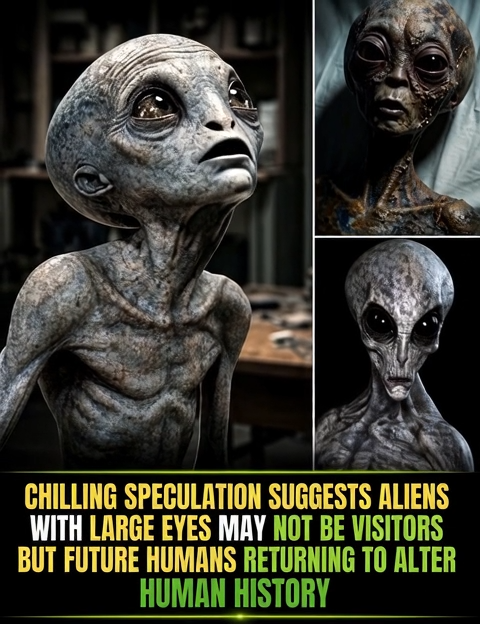
COULD THESE “ALIENS” ACTUALLY BE FUTURE HUMANS? 👽
What if the strange beings imagined in countless stories about extraterrestrial encounters were never visitors from another planet at all?
What if they came from Earth?
And what if they weren’t from our time, but from a future so distant that humanity itself had become almost unrecognizable?
It sounds like the beginning of a science-fiction movie, but the idea raises a fascinating thought experiment about evolution, time travel, and what humans might eventually become after surviving for millions of years.
Imagine humanity continuing far beyond the present day.
Civilizations rise and disappear. Technology advances beyond anything we can currently understand. Human beings adapt to radically different environments. Perhaps some descendants live on other worlds. Others might remain on Earth. Over enormous stretches of time, their bodies, biology, and relationship with technology could change dramatically.
After a million years—or ten million years—would they still look like us?
Probably not necessarily.
That simple question forms the foundation of one of the strangest speculative theories surrounding the idea of extraterrestrial visitors:
What if the “aliens” are actually our descendants?
A HUMANITY THAT NO LONGER LOOKS HUMAN
Human evolution has already transformed our ancestors dramatically over enormous periods of time.
Modern humans did not simply appear overnight.
Our species emerged through a long evolutionary history involving countless generations, environmental changes, migrations, adaptations, and genetic changes.
Now imagine extending that process millions of years into the future.
Future humans could theoretically experience environments completely different from those of today.
Perhaps humanity becomes increasingly dependent on technology.
Perhaps medical science changes the way natural selection operates.
Perhaps humans adapt to low-gravity environments if large populations eventually live away from Earth.
Perhaps genetic engineering allows future civilizations to deliberately modify their own bodies.
Over an unimaginably long period, those changes could produce descendants whose appearance would be difficult for us to recognize.
Large eyes?
Smaller or thinner bodies?
Different facial structures?
Reduced physical strength because machines perform most physical tasks?
Those characteristics are sometimes used in fictional depictions of extraterrestrial beings.
And that creates an intriguing fictional possibility:
What if the classic alien appearance isn’t alien at all?
What if it represents a future branch of humanity?
WHY WOULD FUTURE HUMANS COME BACK?
That leads to an even bigger question.
If these beings were actually our descendants, why would they travel into the distant past?
One possibility in science fiction is observation.
Imagine humanity reaching a point where it can study history directly.
Instead of relying on documents, fossils, recordings, or simulations, future researchers could theoretically observe historical events firsthand.
Earth’s past would become the ultimate archaeological site.
And modern humanity would be one of the most important periods in their history.
Perhaps future scientists would want to observe how civilization developed.
Perhaps they would study major historical events.
Perhaps they would investigate extinct ecosystems.
Or perhaps they would simply want to see what their ancestors looked like before humanity changed beyond recognition.
From that perspective, mysterious encounters could be interpreted as accidental observations by future researchers.
A strange figure appears.
A witness sees something unusual.
The encounter lasts only seconds.
Then the figure disappears.
In a fictional timeline, that could be enough to create centuries of mystery.
BUT THEN COMES THE PROBLEM OF TIME
There is one enormous obstacle.
We currently have no verified scientific evidence that humans can travel backward through time.
Modern physics allows scientists to discuss unusual properties of spacetime, relativity, and hypothetical time-travel scenarios, but none of this establishes that a future civilization could actually travel into our past.
The idea remains speculative.
There is also a fundamental question about causality.
If future humans traveled backward and changed an event in the past, how would that affect the future they originally came from?
Would history split into different timelines?
Would the travelers create an alternate reality?
Would the universe somehow prevent paradoxes?
Science fiction has explored all of these possibilities for decades.
Science, however, has not demonstrated that any of these scenarios occur in reality.
That distinction is important.
The idea of future humans visiting the past is an entertaining thought experiment—not an established explanation for UFO or UAP reports.
COULD EVOLUTION CREATE THE “GREY ALIEN”?
The connection becomes even more interesting when considering the familiar “Grey alien” image.
Large dark eyes.
A narrow face.
A small mouth.
A slender body.
An oversized head.
These features have become deeply ᴀssociated with fictional extraterrestrial beings.
But what if those characteristics represented adaptation rather than extraterrestrial biology?
Perhaps future humans spend generations in environments with very little natural light, causing changes in fictional interpretations of their eyes.
Perhaps their bodies become thinner because advanced technology eliminates the need for physical strength.
Perhaps their skulls become larger because of some imagined evolutionary or technological transformation.
None of these ideas has been demonstrated scientifically.
They are speculative possibilities used by science fiction to ask what humanity might eventually become.
And that is where the concept becomes more interesting than simply saying, “Aliens might be real.”
Instead, the question becomes:
What happens to humanity if it survives long enough?
MILLIONS OF YEARS COULD CHANGE EVERYTHING
We tend to imagine the future in terms of decades.
We picture the year 2050.
Maybe 2100.
Perhaps even 3000.
But millions of years are almost impossible for the human mind to visualize.
The Earth itself has undergone enormous changes over geological timescales.
Continents move.
Climate systems change.
Species disappear.
New species emerge.
Entire ecosystems transform.
Now imagine placing humanity inside that timeline.
If our descendants survive for millions of years, there is no guarantee they would remain biologically identical to modern humans.
They could evolve naturally.
They could modify themselves deliberately.
They could merge biological systems with technology.
They could become adapted to environments that would be impossible for today’s humans.
They might even consider modern humans as distant ancestors in the same way we view much earlier hominin species today.
And if such a civilization eventually discovered a way to observe the past, perhaps our era would become one of the most fascinating chapters in their history.
THE STRANGE POSSIBILITY OF “ALIEN” ENCOUNTERS
This fictional scenario also changes the meaning of an unexplained sighting.
Instead of asking:
“Where did the aliens come from?”
we would ask:
“When did they come from?”
That single change completely transforms the mystery.
A strange object in the sky would no longer necessarily be a spacecraft from another star.
A mysterious humanoid figure would not necessarily be an extraterrestrial.
A reported encounter could, within the fictional scenario, represent a future expedition observing the past.
Perhaps the technology involved would be so advanced that modern humans could not understand it.
Perhaps future visitors would deliberately avoid interacting with us.
Or perhaps they would be studying us precisely because our civilization represents the earliest stages of their own history.
Again, there is no evidence establishing that this is happening.
But as a science-fiction concept, it opens an extraordinary door.
WHAT WOULD OUR DESCENDANTS THINK OF US?
Perhaps the most fascinating part of the idea isn’t what future humans would look like.
It’s what they would think of us.
Would they see modern humanity as primitive?
Would they be fascinated by our technology?
Would they study our languages, cities, wars, cultures, and achievements?
Would they wonder how humanity survived its most dangerous periods?
Would they recognize themselves in us?
Imagine a future researcher standing in a laboratory millions of years from now, examining a digital reconstruction of a human from the 21st century.
The researcher might look at our faces and wonder:
“So this is what we used to be.”
And perhaps, somewhere in that distant future, someone might look back toward the beginning of humanity’s technological age and ask the ultimate question:
“What if we could go there?”
SCIENCE OR SCIENCE FICTION?
For now, the answer is clear.
There is no verified scientific evidence showing that reported extraterrestrial beings are actually future humans.
There is also no established evidence demonstrating that humans can travel backward through time or that mysterious UFO sightings represent visits from our descendants.
The idea belongs to the realm of speculative science fiction.
But that does not make the question uninteresting.
Sometimes the most fascinating thought experiments begin with a question that science cannot currently answer.
If humanity survives for millions of years, evolves, adapts, and transforms beyond recognition, what might our descendants become?
And if they ever developed a way to look backward through time, would they simply observe their ancient ancestors?
Or could some of the strange figures described in human history be the very descendants who came back to see where they began?
Maybe the greatest mystery isn’t whether aliens are out there.
Maybe it’s what humanity itself could become.
⚠️ DISCLAIMER: This is a fictional science-fiction concept created for entertainment and imaginative discussion. There is no verified scientific evidence that extraterrestrial beings are future humans, that UFO sightings represent time travelers, or that humans can travel backward through time.
✓ Team
COULD THESE “ALIENS” ACTUALLY BE FUTURE HUMANS? 👽 What if the strange beings imagined in countless stories about extraterrestrial encounters were never visitors from another planet at…